



Fast Cooling Systems for Higher Graphitization Furnace Productivity
The natural cooling stage is usually the most "boring" and "prolonged" stage in the entire graphitization process-the furnace temperature is already very high, but you still have to wait for it to slowly cool down, and nothing can be done. A complete processing cycle may take 14-16 hours, of which cooling takes 8-12 hours, more than half.
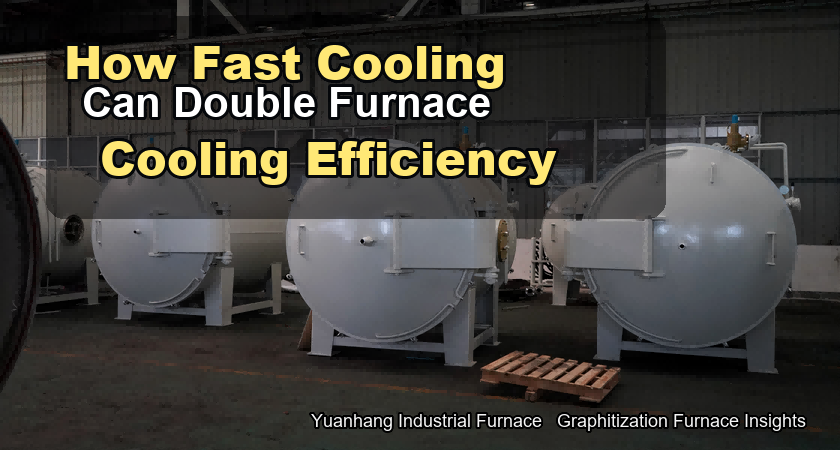
Rapid cooling systems are the engineering solution to this problem, which can reduce the cooling time to a quarter or even less of the original time.
The rapid cooling system utilizes forced gas circulation to quickly remove heat from the furnace interior, and then dissipates the heat into the environment through a high-efficiency heat exchanger outside the furnace. Simply put, it uses a fan to "blow" and a heat exchanger to "dissipate," forcibly accelerating cooling.
Internal Circulation The gas inside the furnace is cooled by the heat exchanger and then returns to the furnace External circulation Exhausting hot gas from the furnace and replenishing it with cooling gas Pursuing the ultimate cooling rate
What the source article emphasizes
The Chinese source focuses on practical furnace selection and operation, not on a simple word-for-word product description. The important point is to understand how each specification affects real batch quality, operating cost, maintenance, and safety.
- Working Principle
- Two Circulation Modes
- Startup conditions
Key technical points
- Cooling water should be monitored by flow, pressure, and temperature, not only by pump running status.
- Independent circuits are preferred for the shell, induction coil, power cabinet, and key electrical components.
- Emergency or redundant cooling should be considered for high-value batches and unattended operation.
- Heating elements and insulation determine maximum temperature, power consumption, maintenance interval, and batch cost.
- Consumable life depends on peak temperature, atmosphere purity, heating and cooling rate, and material volatility.
- Spare hot-zone parts should be discussed during procurement, not only after the first failure.
- Confirm the process temperature, holding time, atmosphere, loading volume, and product quality indicators before comparing suppliers.
- Ask which indicators will be tested at the factory, which will be tested on site, and which need production verification.
Engineering interpretation for overseas buyers
The rapid cooling system cannot be started at any temperature. It is usually only allowed to start when the furnace temperature drops to a certain low-temperature zone (determined by process and product requirements, generally between several hundred and one thousand degrees Celsius).
Rapid cooling when the product temperature is too high may cause thermal stress cracks.
Graphite heating elements may also be damaged during drastic temperature changes.
Let the temperature drop naturally to a safe level before starting rapid cooling.
For an English industrial furnace website, this topic should be presented in a way that helps the reader make a specification decision. That means connecting the furnace feature with material behavior, production rhythm, utility conditions, acceptance testing, and long-term maintenance.
Specification and acceptance checklist
- Cooling water should be monitored by flow, pressure, and temperature, not only by pump running status.
- Independent circuits are preferred for the shell, induction coil, power cabinet, and key electrical components.
- Emergency or redundant cooling should be considered for high-value batches and unattended operation.
- Heating elements and insulation determine maximum temperature, power consumption, maintenance interval, and batch cost.
- Consumable life depends on peak temperature, atmosphere purity, heating and cooling rate, and material volatility.
- Spare hot-zone parts should be discussed during procurement, not only after the first failure.
- Confirm the process temperature, holding time, atmosphere, loading volume, and product quality indicators before comparing suppliers.
- Ask which indicators will be tested at the factory, which will be tested on site, and which need production verification.
Questions to confirm before ordering
- What material will be treated, and what quality indicators must be reached after graphitization?
- What temperature curve, holding time, atmosphere, vacuum level, cooling method, and loading density are required?
- Which data will be recorded for each batch, and which acceptance tests will prove stable performance?
- Which spare parts, consumables, alarms, and maintenance checks are needed for long-term operation?
Engineering takeaway
A graphitization furnace should be specified as a complete high-temperature process system. When the buyer defines the material, process window, utilities, safety logic, and acceptance method clearly, the furnace is easier to operate, easier to troubleshoot, and more reliable in repeated production.



