



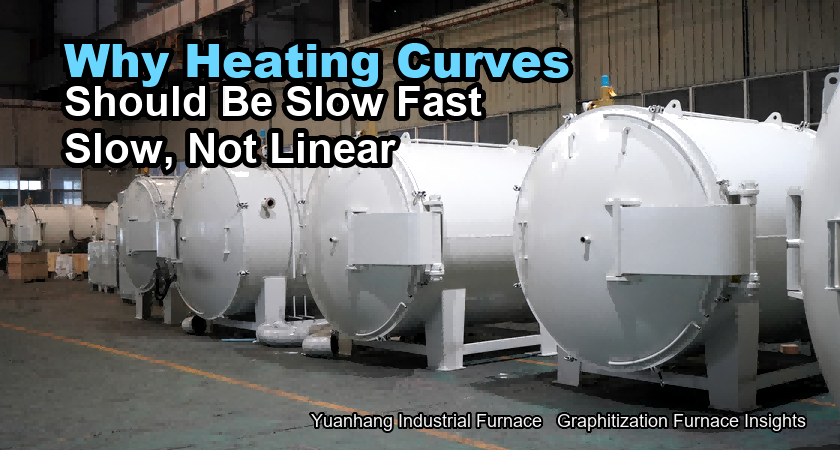
Why Heating Rates Should Be Slow-Fast-Slow in Graphitization
Many beginners operating graphitization furnaces have an intuition-the faster the heating, the higher the efficiency. Why can't we just go straight to the highest power and quickly raise the temperature? The answer is: the heating curve of the graphitization process is usually an
. This is not an artificial limitation, but determined by the physicochemical properties of the materials.
Phase 1: Low Temperature, Slow Speed (RT~800 °C)
This stage, while not hot, requires the most caution. The reasons are:
What the source article emphasizes
The Chinese source focuses on practical furnace selection and operation, not on a simple word-for-word product description. The important point is to understand how each specification affects real batch quality, operating cost, maintenance, and safety.
- Heating Rate Control: Why "Slow-Fast-Slow" Instead of Linear Heating?
Key technical points
- Incomplete graphite crystal development, insufficient graphitization
- Large temperature difference between the inside and outside of the material, overheating of the outer layer and underheating of the inner layer
- Excessive heat load on the heating element, accelerating heat loss
- Heating elements and insulation determine maximum temperature, power consumption, maintenance interval, and batch cost.
- Consumable life depends on peak temperature, atmosphere purity, heating and cooling rate, and material volatility.
- Spare hot-zone parts should be discussed during procurement, not only after the first failure.
- Volatile gas, tar, and dust control should be designed according to actual material chemistry.
- Condensation, filtration, and thermal oxidation are often combined rather than used as isolated devices.
Engineering interpretation for overseas buyers
Adsorbed moisture and residual binders in the carbon material evaporate significantly within this temperature range. Rapid heating can prevent the internal vapor pressure from releasing, potentially causing the material to crack or burst.
Large temperature differences between the inside and outside of the material generate thermal stress. At low temperatures, the material strength is lower, making it more susceptible to cracking due to thermal stress.
Phase 2: Medium Temperature, Rapid Speed (800~2000 °C)
After entering the medium temperature range, the material is relatively stable, volatile substances are largely removed, and the risk of thermal stress decreases. This stage can be achieved by
For an English industrial furnace website, this topic should be presented in a way that helps the reader make a specification decision. That means connecting the furnace feature with material behavior, production rhythm, utility conditions, acceptance testing, and long-term maintenance.
Specification and acceptance checklist
- Heating elements and insulation determine maximum temperature, power consumption, maintenance interval, and batch cost.
- Consumable life depends on peak temperature, atmosphere purity, heating and cooling rate, and material volatility.
- Spare hot-zone parts should be discussed during procurement, not only after the first failure.
- Volatile gas, tar, and dust control should be designed according to actual material chemistry.
- Condensation, filtration, and thermal oxidation are often combined rather than used as isolated devices.
- Environmental compliance should be planned before production, especially for binder-containing carbon materials.
- Confirm the process temperature, holding time, atmosphere, loading volume, and product quality indicators before comparing suppliers.
- Ask which indicators will be tested at the factory, which will be tested on site, and which need production verification.
Questions to confirm before ordering
- What material will be treated, and what quality indicators must be reached after graphitization?
- What temperature curve, holding time, atmosphere, vacuum level, cooling method, and loading density are required?
- Which data will be recorded for each batch, and which acceptance tests will prove stable performance?
- Which spare parts, consumables, alarms, and maintenance checks are needed for long-term operation?
Engineering takeaway
A graphitization furnace should be specified as a complete high-temperature process system. When the buyer defines the material, process window, utilities, safety logic, and acceptance method clearly, the furnace is easier to operate, easier to troubleshoot, and more reliable in repeated production.



