



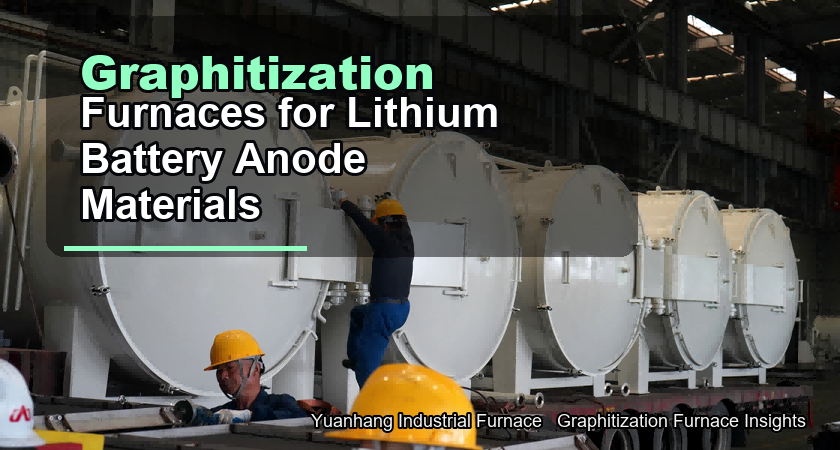
Graphitization Furnaces for Lithium Battery Anode Materials
Artificial graphite is the most mainstream anode material for lithium-ion batteries, accounting for more than 70% of the market share. Graphitization is a key process in the production of artificial graphite, directly determining the electrochemical performance of the anode material.
The main raw materials for artificial graphite anodes are:
Production process: Raw materials → Crushing → Granulation → Graphitization → Screening → Finished product
Graphitization quality directly affects the performance of anode materials:
What the source article emphasizes
The Chinese source focuses on practical furnace selection and operation, not on a simple word-for-word product description. The important point is to understand how each specification affects real batch quality, operating cost, maintenance, and safety.
- Application of Graphitization Furnaces in Lithium-ion Battery Anode Materials
- Raw Materials and Processes
- Graphitization of lithium-ion battery anode materials has the following characteristics
- Performance Indicators
Key technical points
- Needle coke: High-end artificial graphite raw material with good anisotropy
- Petroleum coke: Mid-to-low-end artificial graphite raw material with low cost
- High Temperature: Typically 2800-3200 °C; the higher the degree of graphitization, the higher the capacity.
- Loading Method: Powder materials are loaded in graphite crucibles or graphite boxes.
- Large Batch Size: Single furnace processing capacity can reach tens of tons (box furnace).
- High Power Consumption: Graphitization costs account for 40-50% of the total cost of artificial graphite.
- Specific Capacity: The higher the degree of graphitization, the closer the reversible capacity is to the theoretical value of 372mAh/g
- First-cycle Efficiency: High graphitization degree is beneficial to improving the first-cycle charge-discharge efficiency
Engineering interpretation for overseas buyers
Market: The explosive growth of new energy vehicles has driven a surge in demand for artificial graphite anode materials. Graphitization is the most expensive process in artificial graphite production and also a bottleneck in production capacity. The energy efficiency and production capacity of graphitization furnaces are the core competitiveness of anode material companies.
For an English industrial furnace website, this topic should be presented in a way that helps the reader make a specification decision. That means connecting the furnace feature with material behavior, production rhythm, utility conditions, acceptance testing, and long-term maintenance.
Specification and acceptance checklist
- Loading density must be balanced with temperature uniformity and gas flow.
- Fixtures, spacing, and product orientation can affect both quality and cycle time.
- A loading plan should be tested with real products before it becomes the production standard.
- Energy tracking should be recorded by furnace, batch, recipe, and product type.
- The suitable heating curve is not always the fastest curve or the slowest curve; it should be proven by data.
- Power, holding time, insulation condition, load weight, and utilization all affect the final electricity cost.
- Confirm the process temperature, holding time, atmosphere, loading volume, and product quality indicators before comparing suppliers.
- Ask which indicators will be tested at the factory, which will be tested on site, and which need production verification.
Questions to confirm before ordering
- What material will be treated, and what quality indicators must be reached after graphitization?
- What temperature curve, holding time, atmosphere, vacuum level, cooling method, and loading density are required?
- Which data will be recorded for each batch, and which acceptance tests will prove stable performance?
- Which spare parts, consumables, alarms, and maintenance checks are needed for long-term operation?
Engineering takeaway
A graphitization furnace should be specified as a complete high-temperature process system. When the buyer defines the material, process window, utilities, safety logic, and acceptance method clearly, the furnace is easier to operate, easier to troubleshoot, and more reliable in repeated production.



