



Zone Temperature Control for Large Graphitization Furnaces
Temperature Uniformity in Large Industrial Furnaces: The Implementation Principle of Zoned Temperature Control Technology
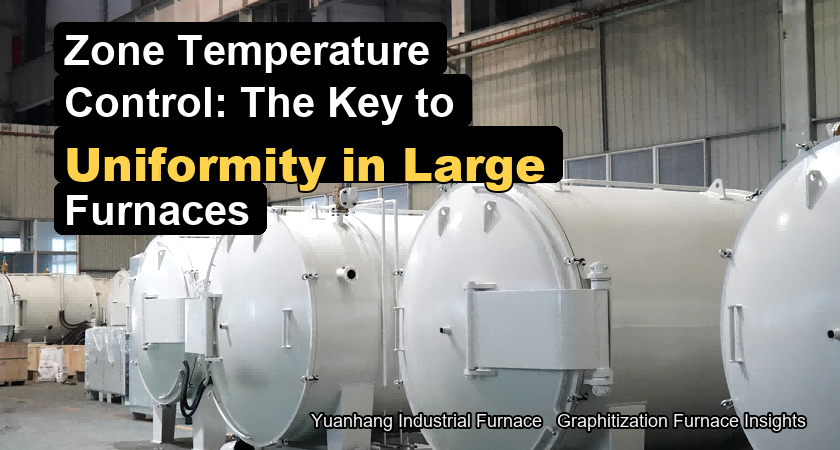
A core challenge faced by large graphitization furnaces is. The larger the furnace chamber, the more pronounced the temperature difference from the center to the edge. If the temperature difference is too large, some products from the same furnace will be over-burned while others are under-burned, resulting in extremely poor product consistency. Controlling temperature uniformity is a significant challenge when high-temperature graphitization furnaces primarily use induction heating.
The core technology for solving the temperature uniformity problem in large furnaces is
What the source article emphasizes
The Chinese source focuses on practical furnace selection and operation, not on a simple word-for-word product description. The important point is to understand how each specification affects real batch quality, operating cost, maintenance, and safety.
- Zoneed Temperature Control Technology
- Independent closed-loop control
- Slight Adjustment of Induction Coil Turn Spacing
- Temperature Field Uniformity Indicators
Key technical points
- Independent heating element: Segmented induction coil design
- Independent temperature sensor: At least one temperature measuring point in each zone
- Independent power regulation unit: Power in each zone is independently controllable
- Temperature difference between any two points within the effective heating zone ≤±10 °C (Large furnace)
- Small laboratory furnace ≤±5 °C
Engineering interpretation for overseas buyers
Dividing the entire furnace along its axial direction (length) into multiple independent temperature zones, each zone is equipped with its own power supply and induction coil, naturally increasing costs significantly:
Each temperature zone constitutes an independent
. The central controller compares the measured temperature and set temperature of each zone in real time and independently adjusts the power output of each zone. If the temperature in the central zone is too low, more power is added; if the temperature in the edge zones is too high, less power is added-each temperature zone operates independently yet coordinates with the others, ultimately controlling the temperature difference throughout the furnace within the target range.
Slightly adjusting the spacing of the induction coils is currently a method for controlling the temperature field uniformity within the furnace.
For an English industrial furnace website, this topic should be presented in a way that helps the reader make a specification decision. That means connecting the furnace feature with material behavior, production rhythm, utility conditions, acceptance testing, and long-term maintenance.
Specification and acceptance checklist
- Define the effective heating zone instead of using total chamber size as the acceptance basis.
- Write the temperature uniformity value and verification method into the technical agreement.
- Use ceramic temperature rings or an equivalent method when high-temperature mapping cannot be measured directly.
- Induction heating is usually more suitable for long-term graphitization above about 2500 °C.
- Resistance heating can be simpler at lower temperatures, but electrode loss and hot-zone life must be considered.
- Compare heating method by process temperature, batch size, uniformity, maintenance, and total operating cost.
- Temperature measurement at graphitization temperatures requires a practical combination of sensor selection, calibration, and indirect verification.
- Thermocouples, infrared systems, and ceramic rings each have different suitable ranges and limitations.
Questions to confirm before ordering
- What material will be treated, and what quality indicators must be reached after graphitization?
- What temperature curve, holding time, atmosphere, vacuum level, cooling method, and loading density are required?
- Which data will be recorded for each batch, and which acceptance tests will prove stable performance?
- Which spare parts, consumables, alarms, and maintenance checks are needed for long-term operation?
Engineering takeaway
A graphitization furnace should be specified as a complete high-temperature process system. When the buyer defines the material, process window, utilities, safety logic, and acceptance method clearly, the furnace is easier to operate, easier to troubleshoot, and more reliable in repeated production.



