



Continuous Graphitization Furnaces and the Future of Production
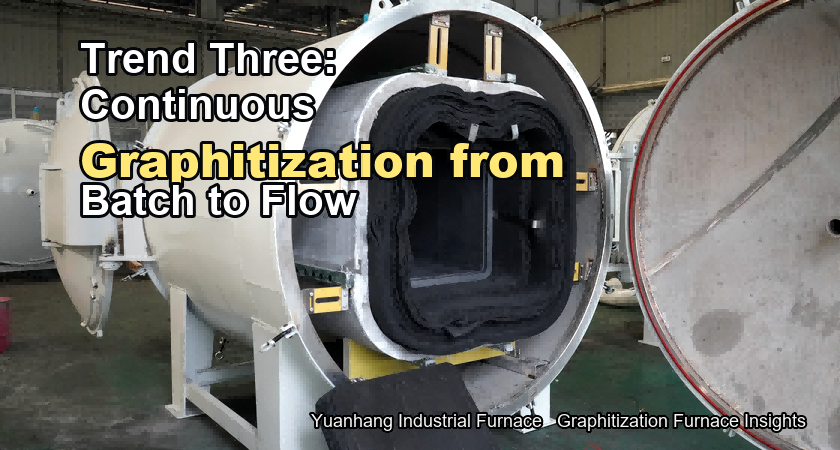
Traditional graphitization furnaces operate intermittently-loading → heating → holding → cooling → unloading, with a cycle typically lasting 15-30 hours, and some large ones even reaching 48 or 72 hours. A significant amount of time is spent on loading, unloading, and heating/cooling, resulting in a low proportion of effective production time. Continuous graphitization furnaces are changing this situation.
The core idea of the continuous graphitization furnace is "material movement, temperature zone stillness":
Trend: Continuous graphitization furnaces are particularly suitable for the mass production of standardized products such as lithium-ion battery anode materials. With the continued growth of the new energy market, continuous graphitization furnaces will become an important development direction for the industry.
What the source article emphasizes
The Chinese source focuses on practical furnace selection and operation, not on a simple word-for-word product description. The important point is to understand how each specification affects real batch quality, operating cost, maintenance, and safety.
- Continuous Graphitization Furnace: A Production Revolution from Intermittent to Continuous
- Working Principle
- Challenges
Key technical points
- The material (powder or preform) continuously enters the furnace through a conveying mechanism.
- The furnace is divided into multiple temperature zones: preheating zone, heating zone, holding zone, and cooling zone.
- The material continuously passes through each temperature zone at a certain speed, completing the graphitization process.
- The processed product is continuously discharged from the discharge end.
- High Capacity: Continuous operation, effective production time is close to 100%, capacity is 3-5 times that of intermittent operation
- Low Energy Consumption: No need for repeated heating and cooling, high thermal energy utilization rate
- Good Consistency: Each batch of material undergoes the same temperature process, with minimal batch-to-batch differences
- Less Manpower: High degree of automation, fewer operators required
Engineering interpretation for overseas buyers
For an English industrial furnace website, this topic should be presented in a way that helps the reader make a specification decision. That means connecting the furnace feature with material behavior, production rhythm, utility conditions, acceptance testing, and long-term maintenance.
Specification and acceptance checklist
- Use vacuum mainly for degassing, impurity removal, and low-temperature process stages.
- At very high temperatures, slight positive argon pressure can suppress graphite sublimation and prevent oxidation.
- The furnace control logic should make atmosphere switching repeatable rather than depending on operator memory.
- Leak checking before heating is essential when processing high-value graphite or carbon materials.
- Water-cooled flanges and suitable O-rings help keep sealing parts below their thermal aging limit.
- A small air leak can oxidize the batch, so sealing design and maintenance records should be part of acceptance.
- Heating elements and insulation determine maximum temperature, power consumption, maintenance interval, and batch cost.
- Consumable life depends on peak temperature, atmosphere purity, heating and cooling rate, and material volatility.
Questions to confirm before ordering
- What material will be treated, and what quality indicators must be reached after graphitization?
- What temperature curve, holding time, atmosphere, vacuum level, cooling method, and loading density are required?
- Which data will be recorded for each batch, and which acceptance tests will prove stable performance?
- Which spare parts, consumables, alarms, and maintenance checks are needed for long-term operation?
Engineering takeaway
A graphitization furnace should be specified as a complete high-temperature process system. When the buyer defines the material, process window, utilities, safety logic, and acceptance method clearly, the furnace is easier to operate, easier to troubleshoot, and more reliable in repeated production.



