



Remote Diagnostics for Faster Graphitization Furnace Troubleshooting
Our graphitization furnace offers remote diagnostics, serving as a fast track for troubleshooting some graphitization furnace malfunctions.
Last month, I received a call from a customer who sounded very anxious. He said the furnace was alarming, and a code was flashing on the screen that the operator couldn't understand and didn't know what to do. I asked him what alarm it was, and he gave me a code. I instructed him to follow the on-screen prompts step by step to troubleshoot, and finally discovered that the filter was clogged. Replacing the filter element solved the problem. The whole process took twenty minutes, without disrupting production.
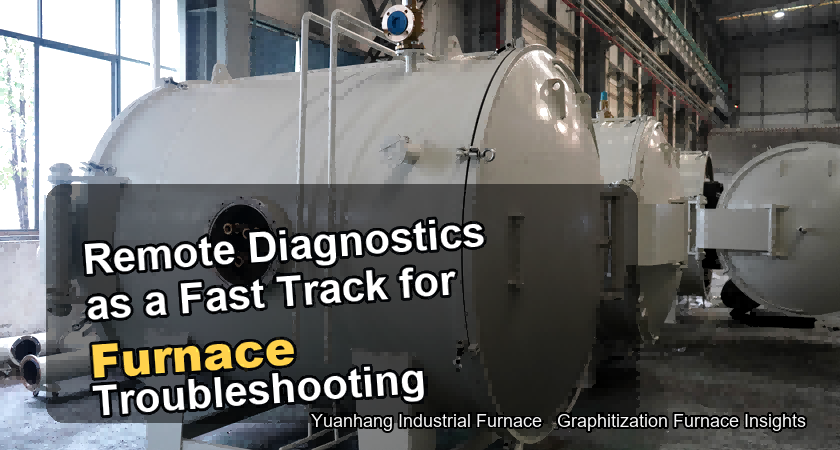
This is the value of remote diagnostics- reducing troubleshooting time from hours to minutes.
Our equipment supports current alarm records, historical alarm records, and quick code lookup for various remote access methods:
What the source article emphasizes
The Chinese source focuses on practical furnace selection and operation, not on a simple word-for-word product description. The important point is to understand how each specification affects real batch quality, operating cost, maintenance, and safety.
- Remote Access Methods
- Real-time Data Synchronization
- Online Troubleshooting Guidance
Key technical points
- VPN Encrypted Connection: Establishes a secure tunnel through the factory network, encrypting data transmission (we will communicate with the customer beforehand to see if IoT cards can be used for data communication)
- 4G/5G Wireless Module: Suitable for scenarios without a fixed network or requiring mobile access
- Cloud Service Relay: Device data is automatically uploaded to the cloud, accessible to authorized personnel at any time
- Use vacuum mainly for degassing, impurity removal, and low-temperature process stages.
- At very high temperatures, slight positive argon pressure can suppress graphite sublimation and prevent oxidation.
- The furnace control logic should make atmosphere switching repeatable rather than depending on operator memory.
- Emergency design should cover power loss, cooling failure, gas interruption, overtemperature, and unsafe pressure.
- UPS, backup gas, safe sealing, and emergency cooling logic should be tested during commissioning.
Engineering interpretation for overseas buyers
All connections are authenticated and encrypted to ensure industrial data security.
After connection, the remote end can see data completely synchronized with the field-current temperature, pressure, power, operating stage, alarm information, and complete real-time and historical process curves. It's like sitting at the control panel in the control room, with everything at your fingertips.
Through voice calls and screen sharing (or on-site video), remote engineers can guide on-site operators step-by-step through troubleshooting. They guide you step-by-step, showing you which valve to open, which sensor to check, and which button to press. For common faults, the average processing time has been reduced from 4 hours (waiting for an engineer to arrive) to 20 minutes.
Case Study: A customer in a remote area experienced an equipment alarm at 2 AM. Through remote diagnostics, our engineers located the issue within 20 minutes as emulsification of the vacuum pump oil causing a decrease in pumping speed. After instructing the on-site team to replace the pump oil, normal operation was restored. Waiting for the engineer to flow in would have resulted in at least a whole day's lost production capacity. Postscript: After equipment acceptance, we consult with customers to see if it can be connected to an IoT card for data communication, enabling us to quickly assist customers in diagnosing faults in the future.
For an English industrial furnace website, this topic should be presented in a way that helps the reader make a specification decision. That means connecting the furnace feature with material behavior, production rhythm, utility conditions, acceptance testing, and long-term maintenance.
Specification and acceptance checklist
- Use vacuum mainly for degassing, impurity removal, and low-temperature process stages.
- At very high temperatures, slight positive argon pressure can suppress graphite sublimation and prevent oxidation.
- The furnace control logic should make atmosphere switching repeatable rather than depending on operator memory.
- Emergency design should cover power loss, cooling failure, gas interruption, overtemperature, and unsafe pressure.
- UPS, backup gas, safe sealing, and emergency cooling logic should be tested during commissioning.
- Alarm records should tell the operator what happened and what response is required.
- Digital interfaces should provide useful production data, not just a remote screen view.
- Temperature curves, power data, pressure trends, alarms, and operator actions are valuable for quality traceability.
Questions to confirm before ordering
- What material will be treated, and what quality indicators must be reached after graphitization?
- What temperature curve, holding time, atmosphere, vacuum level, cooling method, and loading density are required?
- Which data will be recorded for each batch, and which acceptance tests will prove stable performance?
- Which spare parts, consumables, alarms, and maintenance checks are needed for long-term operation?
Engineering takeaway
A graphitization furnace should be specified as a complete high-temperature process system. When the buyer defines the material, process window, utilities, safety logic, and acceptance method clearly, the furnace is easier to operate, easier to troubleshoot, and more reliable in repeated production.



