



Temperature System Calibration for Accurate Graphitization
I once saw a situation that was both laughable and frustrating. A factory's graphitization degree was consistently unstable. After a thorough investigation, it was finally discovered that the infrared thermometer reading was nearly 300 degrees Celsius lower than the actual temperature. Because of this one deviation, all the automatic controls went awry.
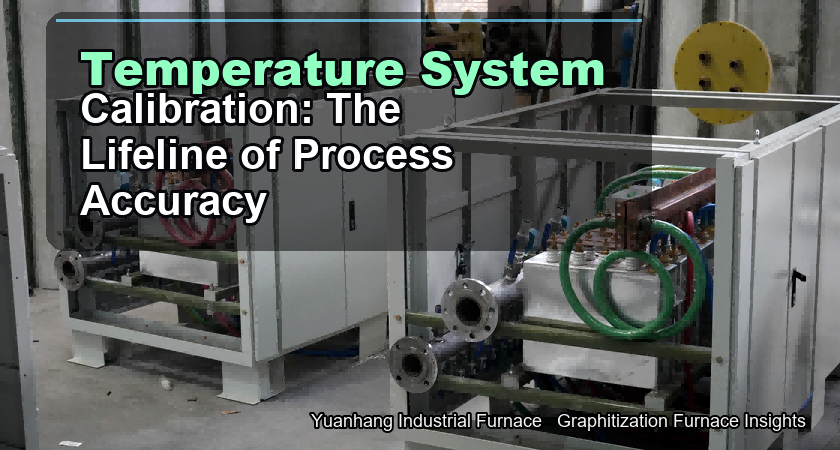
The holding time was sufficient, but the actual temperature wasn't reached, and the product wasn't fully heated. Inaccurate temperature measurement is like the
The dual-color infrared thermometer is a high-precision optical instrument, and drift may occur after a period of use. It is recommended to send it to the manufacturer or a nationally authorized metrology institution every 1 to 2 years for calibration using a blackbody furnace as the standard temperature source. A calibration certificate will be issued after calibration, specifying whether the accuracy of each temperature point meets the standard. This certificate serves as proof of the equipment's condition and is also a document required by the quality management system.
Between two formal calibrations, basic verification can be performed on-site:
We can provide customers with contact services for calibration institutions and assist in arranging inspections. The temperature control accuracy of the entire machine is also verified using calibrated standard temperature measuring equipment when the equipment leaves the factory, ensuring accuracy from the moment it leaves the factory.
What the source article emphasizes
The Chinese source focuses on practical furnace selection and operation, not on a simple word-for-word product description. The important point is to understand how each specification affects real batch quality, operating cost, maintenance, and safety.
- Temperature Measurement System Calibration: The Lifeline for Process Accuracy
- Regular Calibration: Every 1-2 years
- On-site Comparison Verification Method
- Calibration Service
Key technical points
- Place a calibrated type B or type C thermocouple inside the furnace
- After the furnace temperature rises to approximately 1500 °C and stabilizes (too low a temperature is not representative, too high a temperature poses a high operational risk)
- Compare the thermocouple reading with the infrared thermometer reading
- If the deviation is within the allowable range → continue normal use; if the deviation exceeds the limit → send for inspection immediately
Engineering interpretation for overseas buyers
Lesson learned: That factory suffered huge losses because it hadn't performed calibration for two years, resulting in a nearly 300-degree temperature drift without its knowledge. Furthermore, the operators lacked experience and couldn't judge the approximate temperature by the color of the light emitted from the furnace. This led to several batches of products failing to meet graphitization standards. Calibration is an essential expense that shouldn't be skimped on.
For an English industrial furnace website, this topic should be presented in a way that helps the reader make a specification decision. That means connecting the furnace feature with material behavior, production rhythm, utility conditions, acceptance testing, and long-term maintenance.
Specification and acceptance checklist
- Heating elements and insulation determine maximum temperature, power consumption, maintenance interval, and batch cost.
- Consumable life depends on peak temperature, atmosphere purity, heating and cooling rate, and material volatility.
- Spare hot-zone parts should be discussed during procurement, not only after the first failure.
- Temperature measurement at graphitization temperatures requires a practical combination of sensor selection, calibration, and indirect verification.
- Thermocouples, infrared systems, and ceramic rings each have different suitable ranges and limitations.
- Calibration should be treated as routine quality work, not only a commissioning formality.
- Confirm the process temperature, holding time, atmosphere, loading volume, and product quality indicators before comparing suppliers.
- Ask which indicators will be tested at the factory, which will be tested on site, and which need production verification.
Questions to confirm before ordering
- What material will be treated, and what quality indicators must be reached after graphitization?
- What temperature curve, holding time, atmosphere, vacuum level, cooling method, and loading density are required?
- Which data will be recorded for each batch, and which acceptance tests will prove stable performance?
- Which spare parts, consumables, alarms, and maintenance checks are needed for long-term operation?
Engineering takeaway
A graphitization furnace should be specified as a complete high-temperature process system. When the buyer defines the material, process window, utilities, safety logic, and acceptance method clearly, the furnace is easier to operate, easier to troubleshoot, and more reliable in repeated production.



