



Can a Graphitization Furnace Run Unattended with One-Click Start?
Old Zhang has worked in graphitization for fifteen years and always says that in the early days he feared night shifts the most-especially the 2 AM shift. When everyone was exhausted, a single wrong number in the heating curve or a missing zero in the holding time could cause problems with the entire batch of materials. Back then, there was no automation; it all depended on the experience and sense of responsibility of the veteran workers.
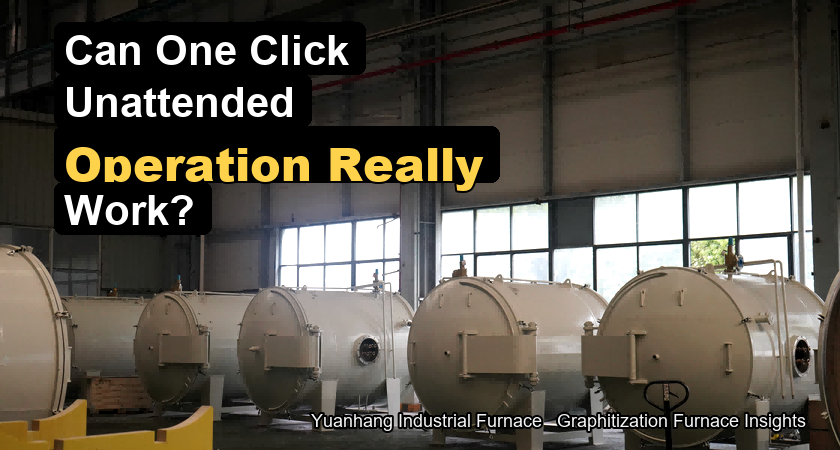
Things have improved in recent years. Our graphitization furnaces can now be loaded, the door closed, a formula selected on the touchscreen, and a start button pressed; the rest is basically unattended.
The entire process is seamless; the operator only needs to press a button at the beginning and remove the furnace at the end.
The PLC is the "brain," with sensors providing real-time feedback on temperature, pressure, flow rate, and water cooling status. Actuators (electric valves, frequency converters, power regulators) precisely execute each instruction. The closed-loop control of sensor→PLC→actuator ensures strict replication of the process curve for each furnace, with batch consistency far exceeding that of manual operation.
What the source article emphasizes
The Chinese source focuses on practical furnace selection and operation, not on a simple word-for-word product description. The important point is to understand how each specification affects real batch quality, operating cost, maintenance, and safety.
- One-click start of the entire process
- Closed-Loop Control Ensures Precise Execution
Key technical points
- Automatic leak detection: The system checks the furnace body's sealing performance, only continuing after confirming there are no leaks-safety first line of defense
- Furnace cleaning and replacement: Automatic vacuuming → charging with protective gas, repeated multiple times to thoroughly remove residual air
- Automatic heating: Strictly follows the formula temperature curve for heating; the timing of rapid and slow heating is entirely controlled by the program. i>
- Heating and Timing: Automatically starts heating and timing upon reaching the target temperature; automatically proceeds to the next stage after the time is up.
- Automatic Cooling: Cools at a set rate; if a rapid cooling system is configured, it automatically starts at a safe temperature.
- Bake Notification: Automatically issues an audible and visual notification when the temperature drops to a safe value, notifying the operator to remove the furnace.
Engineering interpretation for overseas buyers
Core Value: After one-click start, it can run unattended overnight or even on weekends. Just send someone in the morning to check the reports and check the batch. For companies with tight production capacity, the same equipment and personnel configuration can significantly increase output.
For an English industrial furnace website, this topic should be presented in a way that helps the reader make a specification decision. That means connecting the furnace feature with material behavior, production rhythm, utility conditions, acceptance testing, and long-term maintenance.
Specification and acceptance checklist
- Use vacuum mainly for degassing, impurity removal, and low-temperature process stages.
- At very high temperatures, slight positive argon pressure can suppress graphite sublimation and prevent oxidation.
- The furnace control logic should make atmosphere switching repeatable rather than depending on operator memory.
- Leak checking before heating is essential when processing high-value graphite or carbon materials.
- Water-cooled flanges and suitable O-rings help keep sealing parts below their thermal aging limit.
- A small air leak can oxidize the batch, so sealing design and maintenance records should be part of acceptance.
- Heating elements and insulation determine maximum temperature, power consumption, maintenance interval, and batch cost.
- Consumable life depends on peak temperature, atmosphere purity, heating and cooling rate, and material volatility.
Questions to confirm before ordering
- What material will be treated, and what quality indicators must be reached after graphitization?
- What temperature curve, holding time, atmosphere, vacuum level, cooling method, and loading density are required?
- Which data will be recorded for each batch, and which acceptance tests will prove stable performance?
- Which spare parts, consumables, alarms, and maintenance checks are needed for long-term operation?
Engineering takeaway
A graphitization furnace should be specified as a complete high-temperature process system. When the buyer defines the material, process window, utilities, safety logic, and acceptance method clearly, the furnace is easier to operate, easier to troubleshoot, and more reliable in repeated production.



