



Why Graphite Products Need Controlled Cooling After Graphitization
In the graphitization process, controlling the cooling stage is equally important, and it can even be said to be the stage most prone to problems. Many operators only focus on heating and holding, thinking that cooling is simply "turning off the heating and letting it cool down," resulting in the ruin of an entire batch due to rapid cooling.
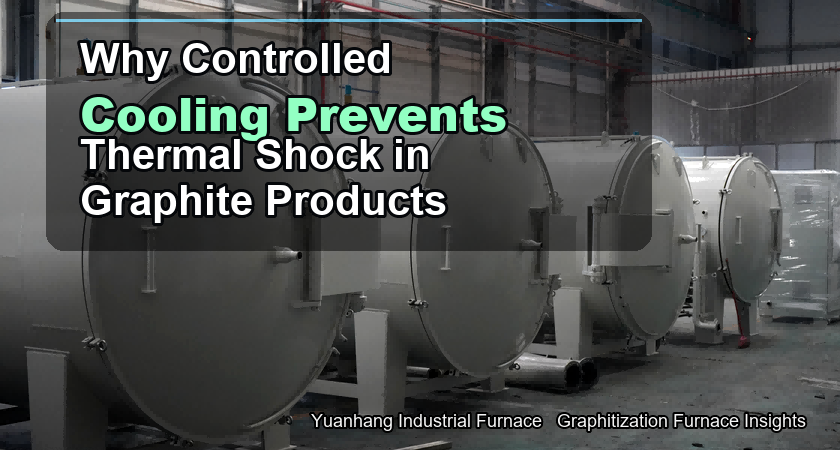
Graphite materials have good thermal conductivity, but their coefficient of thermal expansion is anisotropic-the difference in expansion rate along the crystal plane and perpendicular to the crystal plane is significant. During rapid cooling:
Once a crack forms, the product is scrapped. Moreover, cracks are sometimes micro-cracks, invisible to the naked eye, and the problem only becomes apparent when the product is used in downstream processes or end applications, resulting in even greater losses.
Set the maximum allowable cooling rate based on the material thickness and structural complexity.
What the source article emphasizes
The Chinese source focuses on practical furnace selection and operation, not on a simple word-for-word product description. The important point is to understand how each specification affects real batch quality, operating cost, maintenance, and safety.
- Cooling Control: Why are Graphite Products Afraid of "Rapid Cooling"?
- The Harmful Mechanism of Rapid Cooling
- Scientific Cooling Strategies
- 1?? Control the Cooling Rate
Key technical points
- The material surface contracts rapidly
- The internal temperature is still very high, and the contraction is delayed
- Huge thermal stress is generated both internally and externally
- Stress exceeds the material's strength limit → Cracks
- Thin-walled parts ( 50mm): 1-3 °C/min
Engineering interpretation for overseas buyers
Some materials undergo phase transitions or structural reorganization within specific temperature ranges, resulting in significant volume changes. In these temperature ranges, the cooling rate needs to be reduced to allow the material sufficient time to adapt to the structural changes.
3?? Acceleration possible in low-temperature regions
Once the temperature drops to a lower level (e.g., below 500 °C), the risk of thermal stress in the material is significantly reduced, and the cooling rate can be appropriately accelerated. If a rapid cooling system is configured, it should also be activated at this stage.
Economic Loss: A single batch of large graphite molds cracking due to rapid cooling can result in losses of hundreds of thousands. Temperature control is not a matter of "saving time," but rather "preserving the product." Proper temperature control is more important than any rapid cooling system.
For an English industrial furnace website, this topic should be presented in a way that helps the reader make a specification decision. That means connecting the furnace feature with material behavior, production rhythm, utility conditions, acceptance testing, and long-term maintenance.
Specification and acceptance checklist
- Cooling water should be monitored by flow, pressure, and temperature, not only by pump running status.
- Independent circuits are preferred for the shell, induction coil, power cabinet, and key electrical components.
- Emergency or redundant cooling should be considered for high-value batches and unattended operation.
- Heating elements and insulation determine maximum temperature, power consumption, maintenance interval, and batch cost.
- Consumable life depends on peak temperature, atmosphere purity, heating and cooling rate, and material volatility.
- Spare hot-zone parts should be discussed during procurement, not only after the first failure.
- Confirm the process temperature, holding time, atmosphere, loading volume, and product quality indicators before comparing suppliers.
- Ask which indicators will be tested at the factory, which will be tested on site, and which need production verification.
Questions to confirm before ordering
- What material will be treated, and what quality indicators must be reached after graphitization?
- What temperature curve, holding time, atmosphere, vacuum level, cooling method, and loading density are required?
- Which data will be recorded for each batch, and which acceptance tests will prove stable performance?
- Which spare parts, consumables, alarms, and maintenance checks are needed for long-term operation?
Engineering takeaway
A graphitization furnace should be specified as a complete high-temperature process system. When the buyer defines the material, process window, utilities, safety logic, and acceptance method clearly, the furnace is easier to operate, easier to troubleshoot, and more reliable in repeated production.



