



Why Graphitization Process Development Cannot Rely Only on Simulation
A few months ago, a client from a research institute contacted us, saying they were developing a high-temperature processing technology for a new type of carbon material and asked if we had process simulation software to run a simulation first. Many clients, when developing graphitization processes, often inadvertently ask us if the process can be simulated on a computer first, hoping to save a lot of time and costs. I understand their thinking-using software to simulate the process first avoids wasting expensive experimental materials on real equipment through trial and error.
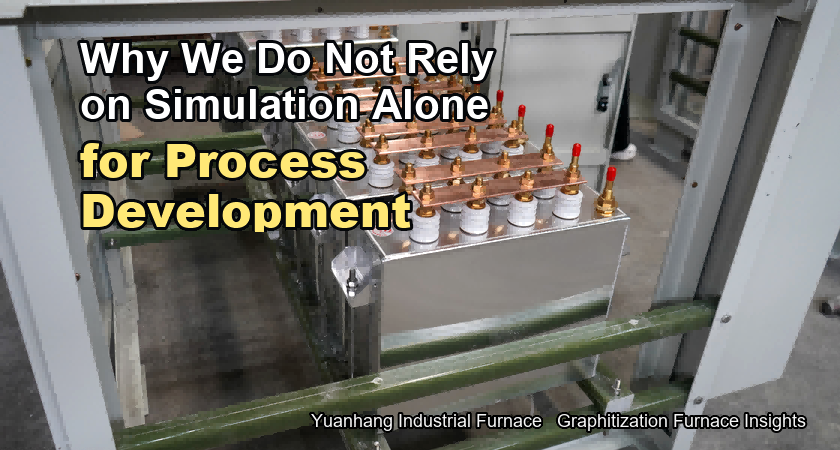
I told them honestly: We don't have process simulation software, and we don't recommend relying on such software for process development. Whether it's the currently popular COMSOL or ANSYS, our advice is that they should only be used as preliminary references.
This might disappoint some clients, since software simulation is already quite mature in many areas of manufacturing. But honesty is more important than promising something you can't deliver.
The physicochemical processes involved in graphitization are extremely complex:
What the source article emphasizes
The Chinese source focuses on practical furnace selection and operation, not on a simple word-for-word product description. The important point is to understand how each specification affects real batch quality, operating cost, maintenance, and safety.
- Graphitization Process Development: Why Don't We Rely on Simulation Software?
- Limitations of Simulation Software
- Experimental verification is the only reliable path
- Collaborative Development Models We Offer
Key technical points
- Multi-physics coupling: Electromagnetic fields, temperature fields, flow fields, and chemical reactions occur simultaneously and influence each other.
- Incomplete material parameters: Accurate data are often lacking for the electromagnetic and thermal properties of novel carbon materials at high temperatures.
- Nonlinear effects: Skin effect, latent heat of phase change, and gas flow are highly nonlinear and difficult to model accurately.
- Uncertain boundary conditions: The heat loss and atmosphere distribution of actual equipment differ significantly from theoretical assumptions.
- Experimental Furnace Testing: Bring samples to our lab, and our process engineers will provide one-on-one support.
- Joint Development: After signing a confidentiality agreement, we will dispatch engineers to our site for joint development.
- Data Accumulation: All experimental data will be fully recorded to provide a basis for subsequent equipment selection.
Engineering interpretation for overseas buyers
These complexities combined significantly reduce the reliability of simulation results. A seemingly beautiful simulation curve may differ greatly from the actual result.
. We accumulate data through extensive actual experiments, continuously adjust parameters, and find the optimal process window. This process may seem slow, but it is actually the fastest path to the goal-because each step accumulates real and effective data, rather than wasting time on illusory simulation results.
Summary: There are no shortcuts in graphitization process development. Simulation software can serve as a supplementary reference, but it cannot replace experimental verification. We are willing to use our more than 20 years of experience to help you develop the process furnace by furnace.
For an English industrial furnace website, this topic should be presented in a way that helps the reader make a specification decision. That means connecting the furnace feature with material behavior, production rhythm, utility conditions, acceptance testing, and long-term maintenance.
Specification and acceptance checklist
- Digital interfaces should provide useful production data, not just a remote screen view.
- Temperature curves, power data, pressure trends, alarms, and operator actions are valuable for quality traceability.
- MES or SCADA integration should be defined by data points, communication protocol, permissions, and reporting needs.
- Confirm the process temperature, holding time, atmosphere, loading volume, and product quality indicators before comparing suppliers.
- Ask which indicators will be tested at the factory, which will be tested on site, and which need production verification.
- Keep one complete batch record for temperature, pressure, power, atmosphere, cooling water, alarms, and operator actions.
- Treat power supply, furnace body, vacuum, gas, cooling, control, and safety as one integrated system.
Questions to confirm before ordering
- What material will be treated, and what quality indicators must be reached after graphitization?
- What temperature curve, holding time, atmosphere, vacuum level, cooling method, and loading density are required?
- Which data will be recorded for each batch, and which acceptance tests will prove stable performance?
- Which spare parts, consumables, alarms, and maintenance checks are needed for long-term operation?
Engineering takeaway
A graphitization furnace should be specified as a complete high-temperature process system. When the buyer defines the material, process window, utilities, safety logic, and acceptance method clearly, the furnace is easier to operate, easier to troubleshoot, and more reliable in repeated production.



