



Automatic Loading Options for Graphitization Furnace Production
Graphitized products are often very heavy (tens to hundreds of kilograms) and brittle. Manual handling is not only inefficient but also prone to damage from bumps and knocks, and poses a risk of workplace injuries. Automated loading and unloading is an effective way to solve these problems.
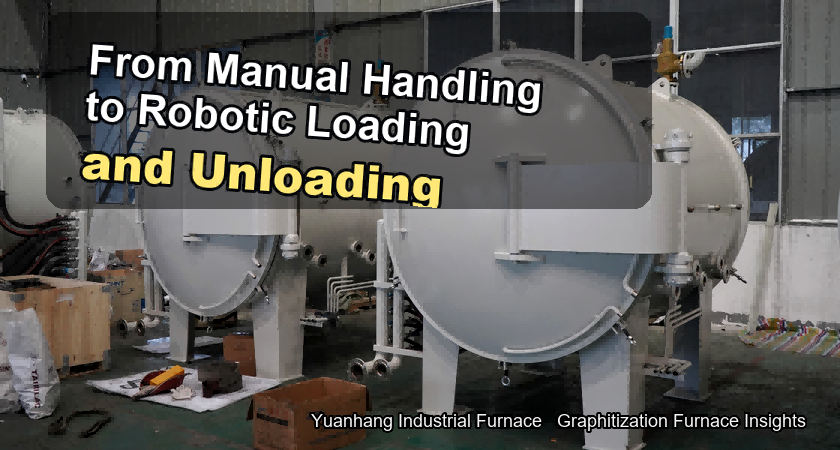
Utilizing a six-axis industrial robot equipped with a specialized gripper (soft contact surface to prevent damage to brittle materials), the following can be achieved:
For mass production of standardized products, roller conveyors or AGV trolleys can be used:
The automated loading and unloading system is equipped with multiple safety protections:
What the source article emphasizes
The Chinese source focuses on practical furnace selection and operation, not on a simple word-for-word product description. The important point is to understand how each specification affects real batch quality, operating cost, maintenance, and safety.
- Robotic Arm Solution
- Safety Design
Key technical points
- Automatic Gripping: Vision positioning + force control for precise gripping of materials of different sizes
- Automatic Transfer: Fully automated path planning from the material rack to the furnace and from the furnace to the cooling zone
- Automatic Stacking: Neatly stacked according to set rules for easy processing in subsequent steps
- The material baskets automatically rotate on the conveyor line.
- Aggregate with the furnace door for automatic push-in/pull-out.
- AGVs automatically transfer materials between multiple furnaces and processes.
- Collision Detection: Real-time monitoring by torque sensors; immediate stop upon collision.
- Anti-Fall: Double protection with vacuum suction cups and mechanical grippers.
Engineering interpretation for overseas buyers
Results: After configuring automated loading and unloading, a customer increased their daily processing capacity from 6 heats to 10 heats (a 40% increase), and workplace injuries during loading and unloading were reduced to zero. The payback period is approximately 1.5 years.
For an English industrial furnace website, this topic should be presented in a way that helps the reader make a specification decision. That means connecting the furnace feature with material behavior, production rhythm, utility conditions, acceptance testing, and long-term maintenance.
Specification and acceptance checklist
- Use vacuum mainly for degassing, impurity removal, and low-temperature process stages.
- At very high temperatures, slight positive argon pressure can suppress graphite sublimation and prevent oxidation.
- The furnace control logic should make atmosphere switching repeatable rather than depending on operator memory.
- Cooling water should be monitored by flow, pressure, and temperature, not only by pump running status.
- Independent circuits are preferred for the shell, induction coil, power cabinet, and key electrical components.
- Emergency or redundant cooling should be considered for high-value batches and unattended operation.
- Loading density must be balanced with temperature uniformity and gas flow.
- Fixtures, spacing, and product orientation can affect both quality and cycle time.
Questions to confirm before ordering
- What material will be treated, and what quality indicators must be reached after graphitization?
- What temperature curve, holding time, atmosphere, vacuum level, cooling method, and loading density are required?
- Which data will be recorded for each batch, and which acceptance tests will prove stable performance?
- Which spare parts, consumables, alarms, and maintenance checks are needed for long-term operation?
Engineering takeaway
A graphitization furnace should be specified as a complete high-temperature process system. When the buyer defines the material, process window, utilities, safety logic, and acceptance method clearly, the furnace is easier to operate, easier to troubleshoot, and more reliable in repeated production.



