



Loading Density and Temperature Uniformity in Vacuum Furnaces
The charging method for graphitization furnaces seems simple-just put the carbon material into the furnace chamber-but in reality, the charging scheme directly affects the temperature uniformity and production efficiency. Overloading results in poor gas flow and uneven temperature; underloading leads to low equipment utilization and high unit cost.
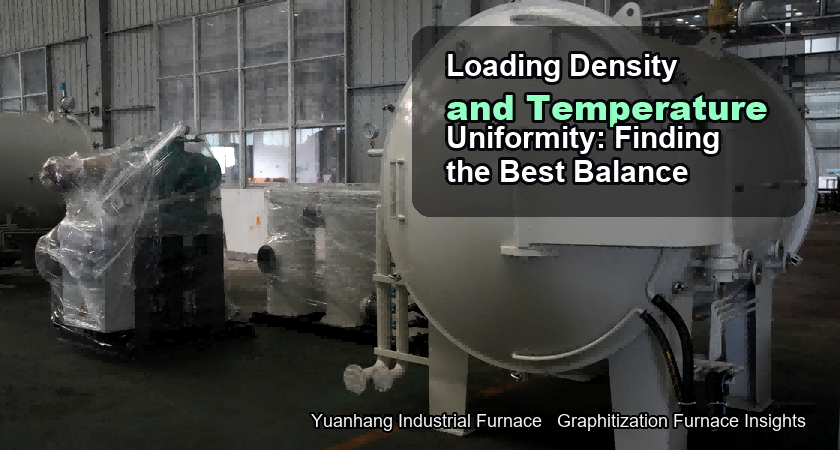
Empirically, a charging density of 60-80% is considered ideal:
Sufficient gaps need to be left between materials to allow for smooth flow of protective gas.
It is generally recommended that the spacing between materials be no less than 50mm, with larger materials requiring even greater spacing.
What the source article emphasizes
The Chinese source focuses on practical furnace selection and operation, not on a simple word-for-word product description. The important point is to understand how each specification affects real batch quality, operating cost, maintenance, and safety.
- Charging Density and Temperature Uniformity: How to Find the Optimal Charging Scheme?
- Charging Density
- Material Spacing
- Symmetrical Placement
- Actual Verification
Key technical points
- Below 60%: Significant waste of furnace space, high heat loss ratio, and high energy consumption per unit product
- 60-80%: A balance between temperature uniformity and equipment utilization rate
- Above 80%: Insufficient material spacing, obstructed protective gas flow, and increased temperature difference between the edge and center
- Uniform Heat Transfer
- Timely Removal of Volatile Substances
- Ensuring Consistent Atmosphere Across All Locations
Engineering interpretation for overseas buyers
Materials should be placed in the furnace as symmetrically and evenly as possible. Avoid piling one side completely full while leaving the other side empty, as this will lead to severe temperature unevenness. For long, strip-shaped materials, they should be placed along the furnace axis to minimize obstruction to gas flow.
The theoretically optimal charging scheme needs to be verified through actual testing. Use ceramic temperature measuring rings at different locations to measure the temperature distribution of a furnace, and adjust the charging scheme based on the results.
After 2-3 rounds of optimization, the optimal charging method can usually be found.
There is no one-size-fits-all standard for charging schemes; they need to be continuously optimized through experiments based on the specific furnace type, material dimensions, and process requirements. A good charging scheme can improve temperature uniformity by more than 30%.
For an English industrial furnace website, this topic should be presented in a way that helps the reader make a specification decision. That means connecting the furnace feature with material behavior, production rhythm, utility conditions, acceptance testing, and long-term maintenance.
Specification and acceptance checklist
- Define the effective heating zone instead of using total chamber size as the acceptance basis.
- Write the temperature uniformity value and verification method into the technical agreement.
- Use ceramic temperature rings or an equivalent method when high-temperature mapping cannot be measured directly.
- Use vacuum mainly for degassing, impurity removal, and low-temperature process stages.
- At very high temperatures, slight positive argon pressure can suppress graphite sublimation and prevent oxidation.
- The furnace control logic should make atmosphere switching repeatable rather than depending on operator memory.
- Loading density must be balanced with temperature uniformity and gas flow.
- Fixtures, spacing, and product orientation can affect both quality and cycle time.
Questions to confirm before ordering
- What material will be treated, and what quality indicators must be reached after graphitization?
- What temperature curve, holding time, atmosphere, vacuum level, cooling method, and loading density are required?
- Which data will be recorded for each batch, and which acceptance tests will prove stable performance?
- Which spare parts, consumables, alarms, and maintenance checks are needed for long-term operation?
Engineering takeaway
A graphitization furnace should be specified as a complete high-temperature process system. When the buyer defines the material, process window, utilities, safety logic, and acceptance method clearly, the furnace is easier to operate, easier to troubleshoot, and more reliable in repeated production.



