



Matching Vacuum Pump Systems to Graphitization Furnace Processes
Can the evacuation system of a graphitization furnace be precisely selected according to process requirements? Vacuum pump set matching instructions
The vacuum requirements for graphitization processes vary greatly. Some materials only require a rough vacuum to remove air, while others require a high vacuum for thorough degassing and impurity removal. Choosing an oversized vacuum pump set wastes investment, while choosing an undersized one will not meet process requirements. How to achieve precise matching?
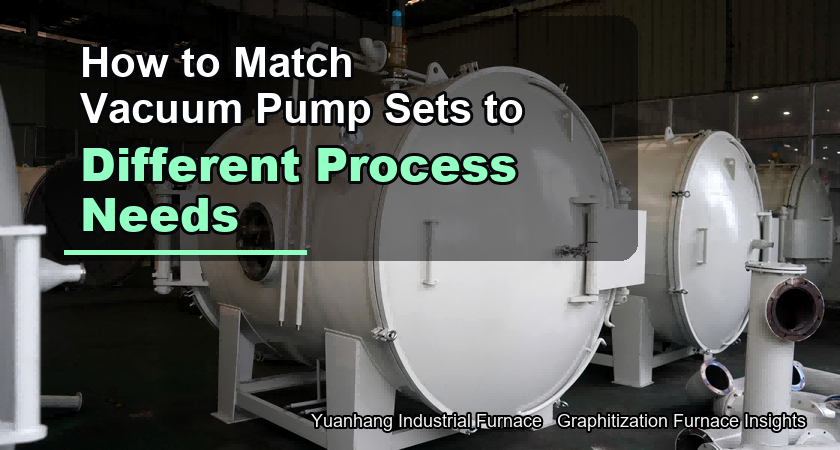
Select the pump set type according to the minimum vacuum required by the process:
High-end materials such as semiconductor-grade graphite and nuclear-grade graphite require high vacuum; rough vacuum is sufficient for ordinary carbon materials.
What the source article emphasizes
The Chinese source focuses on practical furnace selection and operation, not on a simple word-for-word product description. The important point is to understand how each specification affects real batch quality, operating cost, maintenance, and safety.
- Three Selection Dimensions
- 1?? Ultimate Vacuum
- 2?? Pumping Rate
- 3?? Process Gas Characteristics
Key technical points
- Rough Vacuum (10?¹-10?² Pa): Rotary vane pump + Roots pump combination is sufficient
- High Vacuum (10?³-10?? Pa): Diffusion pump or molecular pump is required
- Depending on different vacuum requirements, we will design different output voltages and custom matching of induction coils in the power supply design to avoid arcing and discharge in the furnace
- Charging Capacity: A large furnace and a large amount of material require a higher pumping speed to achieve the target vacuum within the specified time.
- Volatile Amount: Processing materials containing binders releases a large amount of gas, requiring the pump set to have a sufficient pumping speed to "keep up" with it.
Engineering interpretation for overseas buyers
If the process generates condensable gases (water vapor, tar vapor), ordinary oil-sealed pumps are easily contaminated. A condensate trap or scrubbing tower needs to be added before the pump inlet for pretreatment, or a dry pump should be selected. Some processes require the introduction of purge gas to protect the pump body.
Selection Principles: The core principle of vacuum pump sets is "good enough." After evaluating three dimensions-ultimate vacuum, pumping rate, and process adaptability-we select a configuration that just meets the requirements, avoiding over-configuration that wastes investment and under-configuration that affects the process. Depending on different vacuum requirements, we will design different output voltages and custom-matched induction coils in the power supply design to avoid arcing and discharge inside the furnace.
For an English industrial furnace website, this topic should be presented in a way that helps the reader make a specification decision. That means connecting the furnace feature with material behavior, production rhythm, utility conditions, acceptance testing, and long-term maintenance.
Specification and acceptance checklist
- Use vacuum mainly for degassing, impurity removal, and low-temperature process stages.
- At very high temperatures, slight positive argon pressure can suppress graphite sublimation and prevent oxidation.
- The furnace control logic should make atmosphere switching repeatable rather than depending on operator memory.
- Loading density must be balanced with temperature uniformity and gas flow.
- Fixtures, spacing, and product orientation can affect both quality and cycle time.
- A loading plan should be tested with real products before it becomes the production standard.
- Volatile gas, tar, and dust control should be designed according to actual material chemistry.
- Condensation, filtration, and thermal oxidation are often combined rather than used as isolated devices.
Questions to confirm before ordering
- What material will be treated, and what quality indicators must be reached after graphitization?
- What temperature curve, holding time, atmosphere, vacuum level, cooling method, and loading density are required?
- Which data will be recorded for each batch, and which acceptance tests will prove stable performance?
- Which spare parts, consumables, alarms, and maintenance checks are needed for long-term operation?
Engineering takeaway
A graphitization furnace should be specified as a complete high-temperature process system. When the buyer defines the material, process window, utilities, safety logic, and acceptance method clearly, the furnace is easier to operate, easier to troubleshoot, and more reliable in repeated production.



