



Why Graphitization Furnace Thermal Efficiency Has No Fixed Value
Last week, I was talking to a new customer about graphitization furnaces. When we discussed electricity bills, he pointed to our furnace and asked: "What exactly is the thermal efficiency of your furnace? Seventy percent? Eighty percent?" I hesitated for a moment because the answer to this question was more complex than he imagined. "Approximately a certain percentage"-such a simple and direct figure is something graphitization furnaces can't really provide.
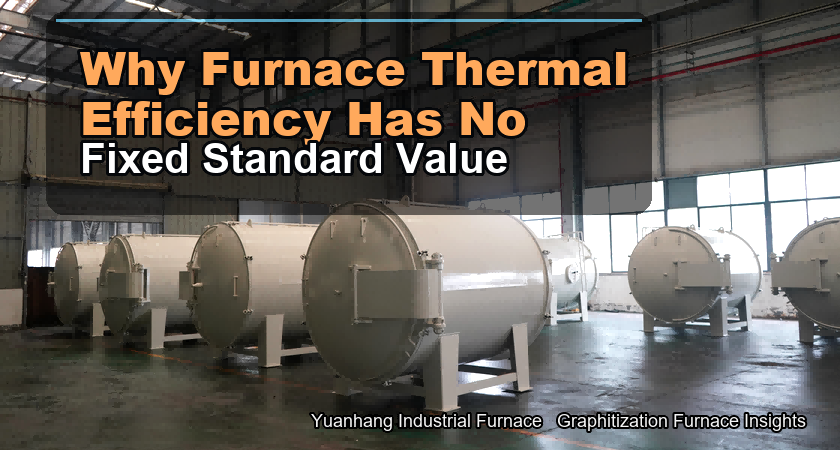
I don't know if he was referring to thermal conversion efficiency or the electrical efficiency of his product, but judging from his state at the time, he was probably referring to the electrical efficiency of his product. He had just joined the company, and I could only tell him that there was no fixed value.
The thermal efficiency of a graphitization furnace doesn't have a nominal value like that of household appliances because it's affected by too many variables:
Instead of pursuing an illusory "efficiency percentage," it's better to use a more practical indicator for evaluation- unit product power consumption (kWh/kg).
What the source article emphasizes
The Chinese source focuses on practical furnace selection and operation, not on a simple word-for-word product description. The important point is to understand how each specification affects real batch quality, operating cost, maintenance, and safety.
- Graphitization Furnace Thermal Efficiency: Why Is There No Fixed Standard Value?
- Scientific evaluation methods
- Three Optimization Directions
Key technical points
- Process parameters: Higher temperatures and longer heating times result in a greater proportion of heat loss.
- Material properties: Different materials have vastly different specific heat capacities and thermal conductivity.
- Loading rate: A full load results in high thermal efficiency; a small load leads to heat loss.
- Insulation performance: Heat loss increases significantly after the insulation layer ages.
- Ambient temperature: Heat loss differs between winter and summer.
- Insulation Layer Maintenance: Regularly inspect and replace aging insulation materials; heat loss can be reduced by 10-15%.
- Heating Curve Optimization: While ensuring product quality, appropriately increase the heating rate to shorten the overall cycle.
- Improving Furnace Loading Rate: Arrange materials rationally, filling the effective heating zone as much as possible to distribute fixed heat loss.
Engineering interpretation for overseas buyers
This indicator comprehensively reflects the overall level of equipment, technology, and operation. For the same type of product and equipment of the same specifications, the lower the unit product power consumption, the better the overall energy efficiency.
Conclusion: Don't ask "What is the thermal efficiency?", ask "How many kilowatt-hours of electricity does it consume to burn one kilogram of product?" This figure is the scientific basis for your cost budget and energy efficiency comparison, allowing us to calculate in detail with customers and provide them with a more accurate value.
For an English industrial furnace website, this topic should be presented in a way that helps the reader make a specification decision. That means connecting the furnace feature with material behavior, production rhythm, utility conditions, acceptance testing, and long-term maintenance.
Specification and acceptance checklist
- Define the effective heating zone instead of using total chamber size as the acceptance basis.
- Write the temperature uniformity value and verification method into the technical agreement.
- Use ceramic temperature rings or an equivalent method when high-temperature mapping cannot be measured directly.
- Heating elements and insulation determine maximum temperature, power consumption, maintenance interval, and batch cost.
- Consumable life depends on peak temperature, atmosphere purity, heating and cooling rate, and material volatility.
- Spare hot-zone parts should be discussed during procurement, not only after the first failure.
- Loading density must be balanced with temperature uniformity and gas flow.
- Fixtures, spacing, and product orientation can affect both quality and cycle time.
Questions to confirm before ordering
- What material will be treated, and what quality indicators must be reached after graphitization?
- What temperature curve, holding time, atmosphere, vacuum level, cooling method, and loading density are required?
- Which data will be recorded for each batch, and which acceptance tests will prove stable performance?
- Which spare parts, consumables, alarms, and maintenance checks are needed for long-term operation?
Engineering takeaway
A graphitization furnace should be specified as a complete high-temperature process system. When the buyer defines the material, process window, utilities, safety logic, and acceptance method clearly, the furnace is easier to operate, easier to troubleshoot, and more reliable in repeated production.



