



Why New Graphitization Furnaces Need Empty-Furnace Purification
About three years ago, a customer who made semiconductor-grade graphite was eager to put his new equipment into production as soon as it was installed and debugged. I understood his feelings-the project schedule was tight, and of course, he wanted to use the equipment as soon as it arrived. But I stopped him at the time, saying, "Don't rush, there's still an important step that hasn't been done: high-temperature dry burning purification." He didn't quite understand at the time, thinking that the equipment had already been tested before leaving the factory, so why burn it again? He probably thought it was just a pure waste of electricity.
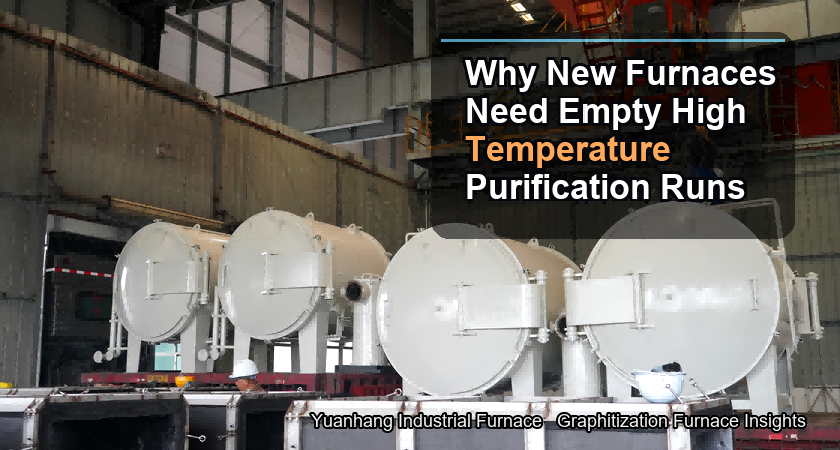
I told him that factory testing, dry burning, furnace drying, and high-temperature purification are two different things.
Factory testing verifies whether the equipment can function properly. Furnace empty-fire purification aims to clean the internal environment of the furnace to meet the requirements of high-purity processes. In new furnaces or furnaces after major repairs, insulation materials, heating elements, and the metal surface of the furnace shell will absorb moisture, grease, and volatile organic compounds. If these substances are not thoroughly removed through high-temperature empty-fire purification, the first batch of high-purity products will have all the contaminants transferred to the products, resulting in substandard purity.
Simply put, it's about "using high temperatures to remove everything that shouldn't be there." Includes:
What the source article emphasizes
The Chinese source focuses on practical furnace selection and operation, not on a simple word-for-word product description. The important point is to understand how each specification affects real batch quality, operating cost, maintenance, and safety.
- Standard Dry Burn Process
Key technical points
- Moisture: Atmospheric moisture adsorbed on insulation materials and metal surfaces
- Grease: Residual processing oils and rust-preventive oils from the manufacturing process
- Volatile Organic Compounds: Residual adhesives and organic matter released from packaging materials
- Surface Oxide Layer: Decomposition of the oxide film on the metal surface under high-temperature reducing atmosphere
- Completely replace the air inside the furnace with a protective gas (high-purity nitrogen or argon).
- Slowly raise the temperature to 150-200 °C under full vacuum, hold for 2-4 hours to allow moisture to evaporate fully, and use a vacuum pump to remove the sublimated water vapor from the furnace.
- Continue to slowly raise the temperature under full vacuum to 800-1000 °C, hold for 4-8 hours to remove organic matter.
- Raise to the maximum operating temperature and hold for several hours to ensure thorough degassing of all components inside the furnace.
Engineering interpretation for overseas buyers
The entire process may require repeated 2-3 cycles, taking several days, until the furnace background environment meets the process requirements and the temperature reaches the level specified in the contract before delivery to the customer.
The customer later followed the advice and performed dry-firing purification, and the purity of the first batch of products met the standards. However, another competitor, rushing to start production at the same time, skipped this step, resulting in the entire first batch of semiconductor-grade graphite failing to meet purity standards, leading to huge losses. The dry-firing and high-temperature purification process for new furnaces is absolutely essential and cannot be omitted.
For an English industrial furnace website, this topic should be presented in a way that helps the reader make a specification decision. That means connecting the furnace feature with material behavior, production rhythm, utility conditions, acceptance testing, and long-term maintenance.
Specification and acceptance checklist
- At about 3000 °C, stable power, high-purity argon, low dew point, and reliable cooling must work as one system.
- For high-purity graphite work, confirm oxygen and moisture control before loading valuable material.
- Nitrogen should not be treated as a simple substitute for argon in ultra-high-temperature graphite service.
- Use vacuum mainly for degassing, impurity removal, and low-temperature process stages.
- At very high temperatures, slight positive argon pressure can suppress graphite sublimation and prevent oxidation.
- The furnace control logic should make atmosphere switching repeatable rather than depending on operator memory.
- Heating elements and insulation determine maximum temperature, power consumption, maintenance interval, and batch cost.
- Consumable life depends on peak temperature, atmosphere purity, heating and cooling rate, and material volatility.
Questions to confirm before ordering
- What material will be treated, and what quality indicators must be reached after graphitization?
- What temperature curve, holding time, atmosphere, vacuum level, cooling method, and loading density are required?
- Which data will be recorded for each batch, and which acceptance tests will prove stable performance?
- Which spare parts, consumables, alarms, and maintenance checks are needed for long-term operation?
Engineering takeaway
A graphitization furnace should be specified as a complete high-temperature process system. When the buyer defines the material, process window, utilities, safety logic, and acceptance method clearly, the furnace is easier to operate, easier to troubleshoot, and more reliable in repeated production.



