



Volatile Gas and Dust Control in Graphitization Furnaces
The summer before last, I received a call from an old client, who sounded very anxious. He said they had recently received a batch of orders for graphitization of pitch-based carbon materials. Because they needed the products urgently, they skipped the pre-carbonization treatment and went directly into the graphitization furnace, extending the low-temperature treatment period in the early stages. During the high-temperature treatment, the volatile matter and dust emanating from the furnace were particularly severe. After only a few batches, a layer of black carbon scale had accumulated on the furnace walls, significantly reducing the insulation effect and causing the product purity to fail to meet standards. Even more troublesome was that the workers in the workshop complained about the pungent odor, and environmental inspections had also raised the warning light.
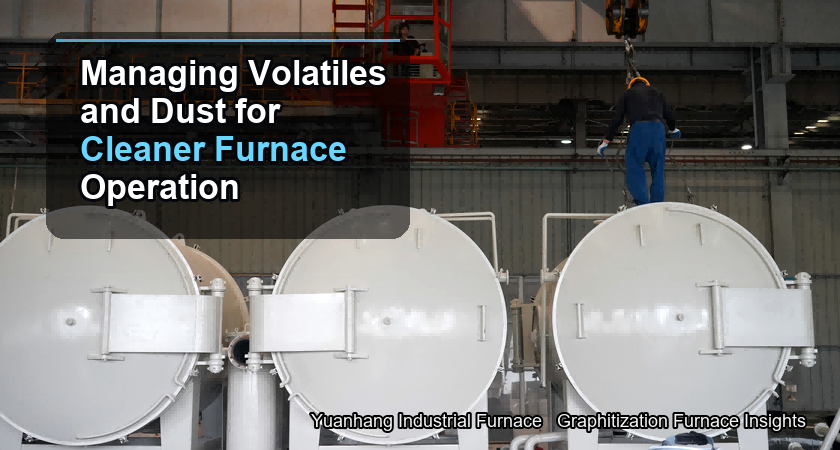
This situation is particularly typical when processing carbon materials containing binders. Binders such as asphalt and resins decompose at high temperatures, producing byproducts such as tar, benzene compounds, and dust. If not effectively managed, this leads to a triple problem: decreased product quality, deteriorated equipment performance, and environmental compliance risks. For these customers who are not concerned about furnace lifespan or the number of furnace cycles, we recommend the following three solutions:
The condensation collection system utilizes the characteristic that tar-like substances in volatiles are gaseous at high temperatures and condense into liquid upon cooling. A condenser (water-cooled or air-cooled) is installed along the exhaust gas path to capture most of the tar and condensable organic matter. The collected liquid can be centrally treated or recycled. This method is low-cost, highly efficient, and suitable for applications with high tar content.
is used for physical interception. Commonly used filter materials include ceramic fiber felt and sintered metal felt, which can withstand temperatures of hundreds or even thousands of degrees Celsius. The filter is installed on the exhaust pipe, and the filter element is cleaned or replaced regularly. This method is very effective in removing particulate matter, but requires regular maintenance; otherwise, blockage will affect the smoothness of exhaust.
What the source article emphasizes
The Chinese source focuses on practical furnace selection and operation, not on a simple word-for-word product description. The important point is to understand how each specification affects real batch quality, operating cost, maintenance, and safety.
- Option Two: Filtration and Purification
- Option Three: High-Temperature Incineration
Key technical points
- Use vacuum mainly for degassing, impurity removal, and low-temperature process stages.
- At very high temperatures, slight positive argon pressure can suppress graphite sublimation and prevent oxidation.
- The furnace control logic should make atmosphere switching repeatable rather than depending on operator memory.
- Heating elements and insulation determine maximum temperature, power consumption, maintenance interval, and batch cost.
- Consumable life depends on peak temperature, atmosphere purity, heating and cooling rate, and material volatility.
- Spare hot-zone parts should be discussed during procurement, not only after the first failure.
- Volatile gas, tar, and dust control should be designed according to actual material chemistry.
- Condensation, filtration, and thermal oxidation are often combined rather than used as isolated devices.
Engineering interpretation for overseas buyers
For gaseous organic matter that cannot be condensed or filtered, the most thorough solution is
(also called thermal oxidation). The exhaust gas is introduced into a combustion chamber, and supplemental fuel heats it to above 800 °C, completely decomposing the organic matter into CO? and H?O, achieving harmless emissions. This method is the most thorough, but the operating cost is high, making it suitable for areas with strict environmental protection requirements.
Practical Recommendation: The three solutions are not mutually exclusive, but complementary. In actual projects, we usually design a combined solution based on the type of materials being treated, the composition of volatile organic compounds, and the emission volume. For example, "condensation + filtration" is suitable for most situations, while "condensation + incineration" is suitable for scenarios with high environmental protection requirements. Regular cleaning and maintenance are key to maintaining the treatment effect.
For an English industrial furnace website, this topic should be presented in a way that helps the reader make a specification decision. That means connecting the furnace feature with material behavior, production rhythm, utility conditions, acceptance testing, and long-term maintenance.
Specification and acceptance checklist
- Use vacuum mainly for degassing, impurity removal, and low-temperature process stages.
- At very high temperatures, slight positive argon pressure can suppress graphite sublimation and prevent oxidation.
- The furnace control logic should make atmosphere switching repeatable rather than depending on operator memory.
- Heating elements and insulation determine maximum temperature, power consumption, maintenance interval, and batch cost.
- Consumable life depends on peak temperature, atmosphere purity, heating and cooling rate, and material volatility.
- Spare hot-zone parts should be discussed during procurement, not only after the first failure.
- Volatile gas, tar, and dust control should be designed according to actual material chemistry.
- Condensation, filtration, and thermal oxidation are often combined rather than used as isolated devices.
Questions to confirm before ordering
- What material will be treated, and what quality indicators must be reached after graphitization?
- What temperature curve, holding time, atmosphere, vacuum level, cooling method, and loading density are required?
- Which data will be recorded for each batch, and which acceptance tests will prove stable performance?
- Which spare parts, consumables, alarms, and maintenance checks are needed for long-term operation?
Engineering takeaway
A graphitization furnace should be specified as a complete high-temperature process system. When the buyer defines the material, process window, utilities, safety logic, and acceptance method clearly, the furnace is easier to operate, easier to troubleshoot, and more reliable in repeated production.



