



IGBT or SCR Power Supply for a Graphitization Furnace?
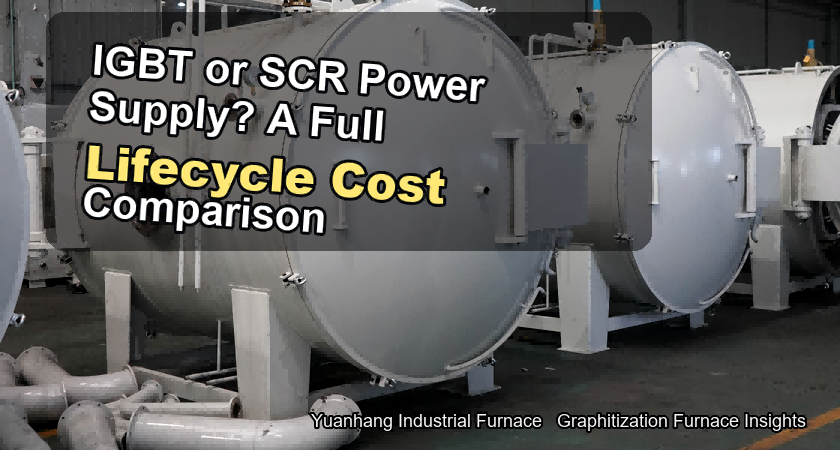
If we compare a graphitization furnace to a person, then the induction heating power supply is its heart. When choosing a power supply solution, many customers struggle with the choice: IGBT or SCR (Semiconductor Rectifier), which should they choose?
Insulated Gate Bipolar Transistor, a fully controllable power electronic device, with power adjusted via high-frequency PWM:
Only Disadvantage: Slightly higher initial purchase cost, but the price difference is quickly recouped through electricity costs.
Semi-controlled devices that regulate power through phase shift control.
What the source article emphasizes
The Chinese source focuses on practical furnace selection and operation, not on a simple word-for-word product description. The important point is to understand how each specification affects real batch quality, operating cost, maintenance, and safety.
- IGBT or SCR? This is a decision that needs careful consideration
- IGBT-Highly Recommended Solution
- SCR (Silicon Controlled Rectifier) - A Budget-Conscious Option
Key technical points
- Extremely High Power Factor: Always maintained above 0.95, maximizing electricity cost efficiency
- Grid Friendly: Extremely low harmonic distortion rate, eliminating the need for bulky filtering devices
- 15%-20% Energy Savings: The electricity cost savings for a high-power furnace can offset the price difference over a year
- Small Size: Saves workshop space
Engineering interpretation for overseas buyers
Low power factor at low power output, harmonics injected into the grid.
Requires additional APF harmonic mitigation device, significant investment and space consumption.
Large size, temperature control precision inferior to IGBTs.
Total Cost Calculation Cannot Be Based Solely on Purchase Price:
For an English industrial furnace website, this topic should be presented in a way that helps the reader make a specification decision. That means connecting the furnace feature with material behavior, production rhythm, utility conditions, acceptance testing, and long-term maintenance.
Specification and acceptance checklist
- Induction heating is usually more suitable for long-term graphitization above about 2500 °C.
- Resistance heating can be simpler at lower temperatures, but electrode loss and hot-zone life must be considered.
- Compare heating method by process temperature, batch size, uniformity, maintenance, and total operating cost.
- Compare IGBT and SCR power systems by power factor, harmonic impact, cabinet size, control precision, and lifetime cost.
- If SCR is selected, evaluate whether APF harmonic filtering and extra electrical room space are required.
- Power quality is not only an electricity issue; it can affect instruments, sensors, and production stability.
- Digital interfaces should provide useful production data, not just a remote screen view.
- Temperature curves, power data, pressure trends, alarms, and operator actions are valuable for quality traceability.
Questions to confirm before ordering
- What material will be treated, and what quality indicators must be reached after graphitization?
- What temperature curve, holding time, atmosphere, vacuum level, cooling method, and loading density are required?
- Which data will be recorded for each batch, and which acceptance tests will prove stable performance?
- Which spare parts, consumables, alarms, and maintenance checks are needed for long-term operation?
Engineering takeaway
A graphitization furnace should be specified as a complete high-temperature process system. When the buyer defines the material, process window, utilities, safety logic, and acceptance method clearly, the furnace is easier to operate, easier to troubleshoot, and more reliable in repeated production.



