



Factory Foundation and Access Planning for Graphitization Furnaces
If I had to say what's most easily overlooked by customers yet has the most serious consequences, it would definitely be the load-bearing capacity of the factory floor. I've seen equipment arrive at the factory gate only to discover that the floor's load-bearing capacity is insufficient, forcing temporary work stoppages for rectification and delays of one or two weeks in the construction period.
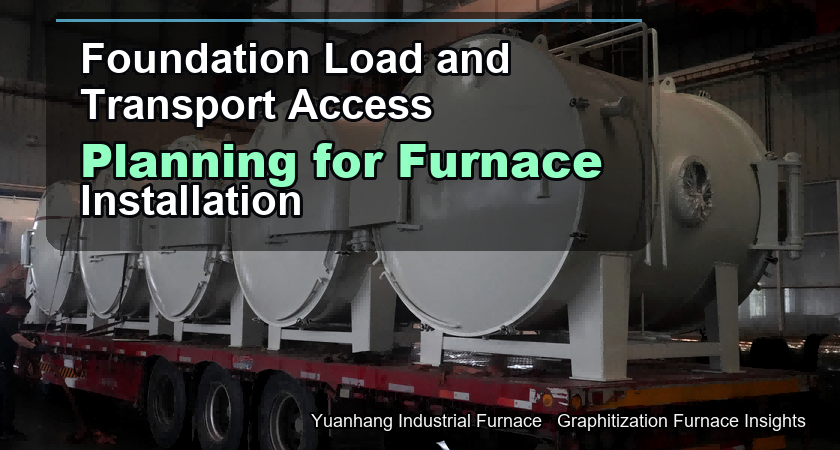
Our equipment is 100% non-standard customized; different specifications can vary in weight by tens of times.
Total equipment weight, maximum single-piece weight and dimensions
Anchor bolt locations and foundation pit dimensions
What the source article emphasizes
The Chinese source focuses on practical furnace selection and operation, not on a simple word-for-word product description. The important point is to understand how each specification affects real batch quality, operating cost, maintenance, and safety.
- Equipment Weight and Foundation Requirements
Key technical points
- Are the height and width of the factory gate sufficient?
- Is the turning radius large enough?
- Is the internal passageway space in the workshop sufficient?
- Are there any obstructions such as pipes or cable trays above the passageway?
- Is the crane's lifting capacity and hoisting height sufficient?
Engineering interpretation for overseas buyers
Strict requirements for foundation construction
Construction according to the foundation layout drawing; ensure concrete is fully cured to design strength
Curing period: at least 21 days in summer, at least 28 days in winter
Installation on surfaces with insufficient load-bearing capacity is strictly prohibited
For an English industrial furnace website, this topic should be presented in a way that helps the reader make a specification decision. That means connecting the furnace feature with material behavior, production rhythm, utility conditions, acceptance testing, and long-term maintenance.
Specification and acceptance checklist
- Loading density must be balanced with temperature uniformity and gas flow.
- Fixtures, spacing, and product orientation can affect both quality and cycle time.
- A loading plan should be tested with real products before it becomes the production standard.
- Temperature measurement at graphitization temperatures requires a practical combination of sensor selection, calibration, and indirect verification.
- Thermocouples, infrared systems, and ceramic rings each have different suitable ranges and limitations.
- Calibration should be treated as routine quality work, not only a commissioning formality.
- Acceptance criteria should be measurable and written into the contract before manufacturing is completed.
- Site readiness, utilities, lifting, foundation, gas supply, cooling water, and exhaust treatment all affect commissioning.
Questions to confirm before ordering
- What material will be treated, and what quality indicators must be reached after graphitization?
- What temperature curve, holding time, atmosphere, vacuum level, cooling method, and loading density are required?
- Which data will be recorded for each batch, and which acceptance tests will prove stable performance?
- Which spare parts, consumables, alarms, and maintenance checks are needed for long-term operation?
Engineering takeaway
A graphitization furnace should be specified as a complete high-temperature process system. When the buyer defines the material, process window, utilities, safety logic, and acceptance method clearly, the furnace is easier to operate, easier to troubleshoot, and more reliable in repeated production.



