



How Gas Sealing Protects Materials in Graphitization Furnaces
At the end of the year before last, a customer called, saying that a furnace of high-purity graphite material had completely oxidized and turned white, rendering the entire furnace unusable. The problem ultimately stemmed from an inconspicuous O-ring; the customer hadn't performed a crucial leak check before starting the furnace. -An aged and deformed fluororubber ring on the flange sealing surface allowed a small amount of air to leak into the furnace.
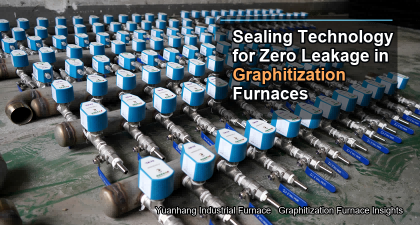
On all major sealing surfaces-furnace door, electrode leads, and pipe interfaces-a metal flange with a built-in water-cooling channel is designed. Cooling water flows continuously, strictly controlling the flange temperature below 60 °C.
Made of high-quality fluororubber material, with a long-term operating temperature range of -20 °C to +200 °C. Under water-cooling protection, the actual operating temperature is far below the upper limit of the temperature resistance, almost eliminating thermal aging and maintaining consistent elasticity and sealing performance for decades.
Each piece of equipment undergoes rigorous pressure rise rate testing before leaving the factory and during on-site acceptance, and the data is recorded in the acceptance report.
What the source article emphasizes
The Chinese source focuses on practical furnace selection and operation, not on a simple word-for-word product description. The important point is to understand how each specification affects real batch quality, operating cost, maintenance, and safety.
- A single drop of argon leaked in, rendering the entire furnace unusable.
- Core Sealing Design
- Water-Cooled Flange
- Fluororubber O-rings
- Sealing Performance Quantification Standards
Key technical points
- Micro Positive Pressure Furnace: After closing all valves, the pressure rise rate is ≤100Pa/h
- Vacuum Furnace: After turning off the vacuum pump, the pressure rise rate is ≤0.67Pa/min (approximately 40Pa/h)
- At about 3000 °C, stable power, high-purity argon, low dew point, and reliable cooling must work as one system.
- For high-purity graphite work, confirm oxygen and moisture control before loading valuable material.
- Nitrogen should not be treated as a simple substitute for argon in ultra-high-temperature graphite service.
- Use vacuum mainly for degassing, impurity removal, and low-temperature process stages.
- At very high temperatures, slight positive argon pressure can suppress graphite sublimation and prevent oxidation.
- The furnace control logic should make atmosphere switching repeatable rather than depending on operator memory.
Engineering interpretation for overseas buyers
Maintenance Recommendations: All O-rings are installed in easily removable water-cooled flange grooves. During annual maintenance, check the condition of the O-rings-for signs of aging, hardening, cracking, deformation, or chemical corrosion. Replace them promptly if problems are found; don't wait until a leak occurs. A set of O-rings doesn't cost much, but the loss from scrapping an entire batch of products can be substantial.
For an English industrial furnace website, this topic should be presented in a way that helps the reader make a specification decision. That means connecting the furnace feature with material behavior, production rhythm, utility conditions, acceptance testing, and long-term maintenance.
Specification and acceptance checklist
- At about 3000 °C, stable power, high-purity argon, low dew point, and reliable cooling must work as one system.
- For high-purity graphite work, confirm oxygen and moisture control before loading valuable material.
- Nitrogen should not be treated as a simple substitute for argon in ultra-high-temperature graphite service.
- Use vacuum mainly for degassing, impurity removal, and low-temperature process stages.
- At very high temperatures, slight positive argon pressure can suppress graphite sublimation and prevent oxidation.
- The furnace control logic should make atmosphere switching repeatable rather than depending on operator memory.
- Leak checking before heating is essential when processing high-value graphite or carbon materials.
- Water-cooled flanges and suitable O-rings help keep sealing parts below their thermal aging limit.
Questions to confirm before ordering
- What material will be treated, and what quality indicators must be reached after graphitization?
- What temperature curve, holding time, atmosphere, vacuum level, cooling method, and loading density are required?
- Which data will be recorded for each batch, and which acceptance tests will prove stable performance?
- Which spare parts, consumables, alarms, and maintenance checks are needed for long-term operation?
Engineering takeaway
A graphitization furnace should be specified as a complete high-temperature process system. When the buyer defines the material, process window, utilities, safety logic, and acceptance method clearly, the furnace is easier to operate, easier to troubleshoot, and more reliable in repeated production.



