



Why Cooling Systems Are Critical in Graphitization Furnaces
Just as humans rely on blood circulation to remove heat and maintain a stable body temperature, the graphitization furnace works the same way. The cooling system is the life support system for this massive machine.
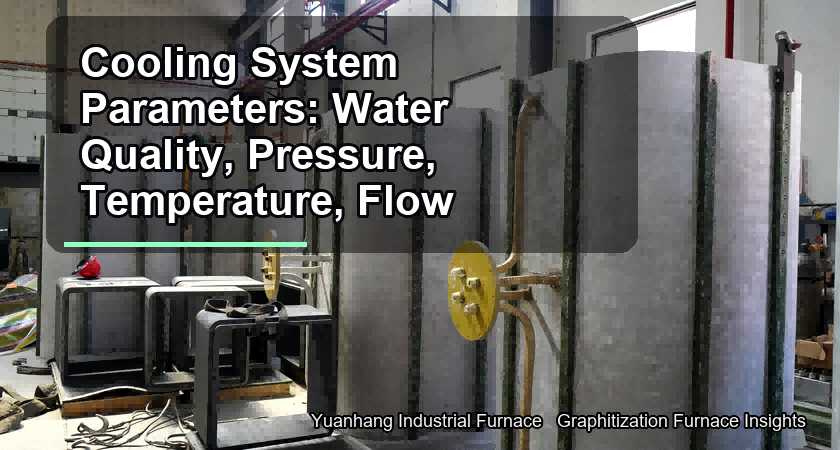
Water Quality Softened Water/Deionized Water Winter freeze protection, summer heat dissipation efficiency
Flow rate 10-50m³/h Each unit is equipped with a flow meter and alarm device
The equipment has multiple independent cooling circuits, which precisely cool key components such as the induction coil, capacitors in the power cabinet, and power devices such as thyristors. Each circuit has independent flow and temperature monitoring.
What the source article emphasizes
The Chinese source focuses on practical furnace selection and operation, not on a simple word-for-word product description. The important point is to understand how each specification affects real batch quality, operating cost, maintenance, and safety.
- The cooling system is the equipment's circulatory system
- Four Key Parameters
- Multi-Circuit Independent Cooling
Key technical points
- The furnace shell surface temperature is controlled safely below 50 °C, preventing burns to operators.
- Reducing heat dissipation from the furnace body to the surrounding environment, thus saving energy to a certain extent.
- Combined with a graphite felt insulation layer, effectively reducing heat loss.
- Compare IGBT and SCR power systems by power factor, harmonic impact, cabinet size, control precision, and lifetime cost.
- If SCR is selected, evaluate whether APF harmonic filtering and extra electrical room space are required.
- Power quality is not only an electricity issue; it can affect instruments, sensors, and production stability.
- Cooling water should be monitored by flow, pressure, and temperature, not only by pump running status.
- Independent circuits are preferred for the shell, induction coil, power cabinet, and key electrical components.
Engineering interpretation for overseas buyers
Safety Considerations: All our equipment is equipped with water flow and temperature detection and alarm systems. In actual production, if one pipe is blocked, the entire system will face a cascading risk of overheating. If a problem occurs in a specific circuit, our electrical control system will precisely pinpoint the exact branch.
For an English industrial furnace website, this topic should be presented in a way that helps the reader make a specification decision. That means connecting the furnace feature with material behavior, production rhythm, utility conditions, acceptance testing, and long-term maintenance.
Specification and acceptance checklist
- Compare IGBT and SCR power systems by power factor, harmonic impact, cabinet size, control precision, and lifetime cost.
- If SCR is selected, evaluate whether APF harmonic filtering and extra electrical room space are required.
- Power quality is not only an electricity issue; it can affect instruments, sensors, and production stability.
- Cooling water should be monitored by flow, pressure, and temperature, not only by pump running status.
- Independent circuits are preferred for the shell, induction coil, power cabinet, and key electrical components.
- Emergency or redundant cooling should be considered for high-value batches and unattended operation.
- Heating elements and insulation determine maximum temperature, power consumption, maintenance interval, and batch cost.
- Consumable life depends on peak temperature, atmosphere purity, heating and cooling rate, and material volatility.
Questions to confirm before ordering
- What material will be treated, and what quality indicators must be reached after graphitization?
- What temperature curve, holding time, atmosphere, vacuum level, cooling method, and loading density are required?
- Which data will be recorded for each batch, and which acceptance tests will prove stable performance?
- Which spare parts, consumables, alarms, and maintenance checks are needed for long-term operation?
Engineering takeaway
A graphitization furnace should be specified as a complete high-temperature process system. When the buyer defines the material, process window, utilities, safety logic, and acceptance method clearly, the furnace is easier to operate, easier to troubleshoot, and more reliable in repeated production.



