



Recipe Locking and Operation Logs for Graphitization Furnaces
Two years ago, when I was installing and commissioning equipment for a large carbon materials company, one of the operators was a novice who had only been working there for less than two months. One night shift, while idly clicking around on the interface, he accidentally changed a running process formula, completely messing up the temperature curve. Fortunately, the experienced technician on duty noticed in time and quickly switched to manual mode to stabilize the temperature, so only a small portion of the batch of products was ruined.
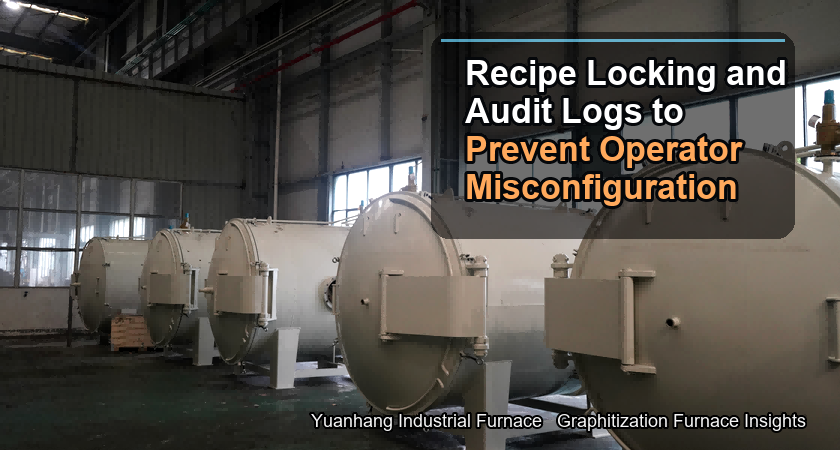
This incident made us deeply realize the importance of the process formula locking function-it's like adding a lock to a safe for the formula.
Our control system has a strict rule: As long as the equipment is running, the currently loaded recipe automatically enters a locked state, making it impossible for anyone to edit or modify it. The recipe editing button on the user interface becomes grayed out and unclickable; even the most privileged administrator cannot modify the recipe while it is running. Want to change the recipe? Stop the machine first, then make the modification, then restart. This design eliminates the possibility of accidental parameter modification during operation from the outset.
Even after equipment shutdown, modifying recipes is not something anyone can do:
What the source article emphasizes
The Chinese source focuses on practical furnace selection and operation, not on a simple word-for-word product description. The important point is to understand how each specification affects real batch quality, operating cost, maintenance, and safety.
- Process Formula Locking: A Safe Haven to Prevent Novices from Accidentally Changing Parameters
- Automatic Recipe Locking During Operation
- Separation of Access Rights
- Traceable Modification Tracking
Key technical points
- Operator: Can only access authorized recipes, not edit them.
- Process Engineer: Can edit recipes, but requires administrator password confirmation.
- Administrator: Can edit recipes and system settings; all operations are recorded in the audit log.
- Recipe management is useful only when version control and permissions prevent uncontrolled parameter changes.
- Operators should be allowed to run approved recipes, while engineers control creation and modification.
- Operation logs help protect both product quality and process know-how.
- Acceptance criteria should be measurable and written into the contract before manufacturing is completed.
- Site readiness, utilities, lifting, foundation, gas supply, cooling water, and exhaust treatment all affect commissioning.
Engineering interpretation for overseas buyers
The creation, modification, and deletion of any recipe are recorded in a detailed audit log-who, when, what parameters were changed, and from what value to what value. These logs are
, providing irrefutable evidence for quality traceability and problem analysis.
Result: After implementing recipe locking and access control, there have been no more incidents of recipes being accidentally modified during operation. Technical methods are more reliable than regulations because they do not rely on human memory or attention.
For an English industrial furnace website, this topic should be presented in a way that helps the reader make a specification decision. That means connecting the furnace feature with material behavior, production rhythm, utility conditions, acceptance testing, and long-term maintenance.
Specification and acceptance checklist
- Recipe management is useful only when version control and permissions prevent uncontrolled parameter changes.
- Operators should be allowed to run approved recipes, while engineers control creation and modification.
- Operation logs help protect both product quality and process know-how.
- Acceptance criteria should be measurable and written into the contract before manufacturing is completed.
- Site readiness, utilities, lifting, foundation, gas supply, cooling water, and exhaust treatment all affect commissioning.
- Trial production data is more useful than a simple no-load running record.
- Confirm the process temperature, holding time, atmosphere, loading volume, and product quality indicators before comparing suppliers.
- Ask which indicators will be tested at the factory, which will be tested on site, and which need production verification.
Questions to confirm before ordering
- What material will be treated, and what quality indicators must be reached after graphitization?
- What temperature curve, holding time, atmosphere, vacuum level, cooling method, and loading density are required?
- Which data will be recorded for each batch, and which acceptance tests will prove stable performance?
- Which spare parts, consumables, alarms, and maintenance checks are needed for long-term operation?
Engineering takeaway
A graphitization furnace should be specified as a complete high-temperature process system. When the buyer defines the material, process window, utilities, safety logic, and acceptance method clearly, the furnace is easier to operate, easier to troubleshoot, and more reliable in repeated production.



