



Operator Training for Graphitization Furnace Customers
Graphitization furnaces are complex devices involving the coupling of multiple systems, including high temperature, vacuum, electrical, and water cooling. Improper operation can lead to equipment damage or even personal injury. Systematic operation training is essential.
Practice in the equipment simulation system or offline mode:
Simulated operation allows for safe mistakes without causing damage to equipment or products.
Practical operation under the guidance of experienced instructors:
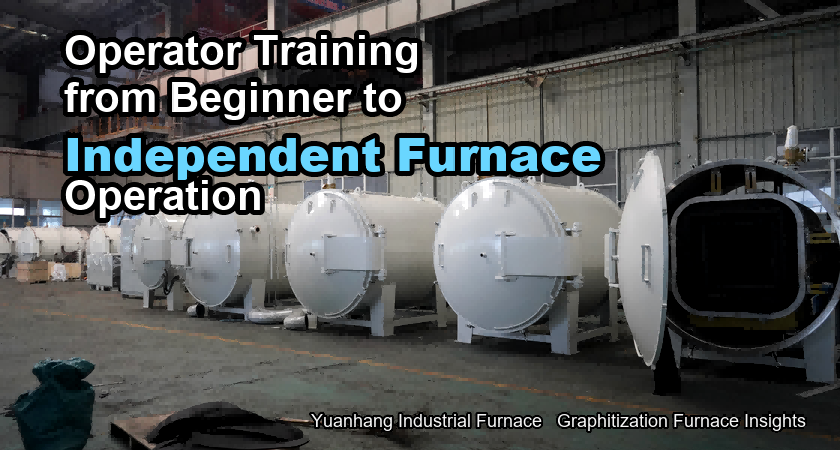
What the source article emphasizes
The Chinese source focuses on practical furnace selection and operation, not on a simple word-for-word product description. The important point is to understand how each specification affects real batch quality, operating cost, maintenance, and safety.
- Phase 1: Theoretical Training (1 week)
- Phase Two: Simulated Operation (1 week)
Key technical points
- Equipment Principles: Basic principles of graphitization process, equipment structure and workflow
- Safety Knowledge: High-temperature burns, vacuum safety, electrical safety, gas safety
- Process Fundamentals: Temperature profile design, atmosphere control, charging methods
- Operating Procedures: Standard Operating Procedures (SOP), emergency handling
- Familiarize yourself with the interface operation
- Process recipe calling and editing
- Alarm handling practice
- Emergency situation simulation
Engineering interpretation for overseas buyers
Observe an experienced instructor operating a complete batch of equipment.
Gradually participate in each stage under the supervision of an experienced instructor.
Operate independently with guidance from an experienced instructor.
Upon passing the theoretical and practical assessments, an
For an English industrial furnace website, this topic should be presented in a way that helps the reader make a specification decision. That means connecting the furnace feature with material behavior, production rhythm, utility conditions, acceptance testing, and long-term maintenance.
Specification and acceptance checklist
- Use vacuum mainly for degassing, impurity removal, and low-temperature process stages.
- At very high temperatures, slight positive argon pressure can suppress graphite sublimation and prevent oxidation.
- The furnace control logic should make atmosphere switching repeatable rather than depending on operator memory.
- Loading density must be balanced with temperature uniformity and gas flow.
- Fixtures, spacing, and product orientation can affect both quality and cycle time.
- A loading plan should be tested with real products before it becomes the production standard.
- Recipe management is useful only when version control and permissions prevent uncontrolled parameter changes.
- Operators should be allowed to run approved recipes, while engineers control creation and modification.
Questions to confirm before ordering
- What material will be treated, and what quality indicators must be reached after graphitization?
- What temperature curve, holding time, atmosphere, vacuum level, cooling method, and loading density are required?
- Which data will be recorded for each batch, and which acceptance tests will prove stable performance?
- Which spare parts, consumables, alarms, and maintenance checks are needed for long-term operation?
Engineering takeaway
A graphitization furnace should be specified as a complete high-temperature process system. When the buyer defines the material, process window, utilities, safety logic, and acceptance method clearly, the furnace is easier to operate, easier to troubleshoot, and more reliable in repeated production.



