



Factory Layout, Height, and Lifting for Graphitization Furnaces
Because we specialize in non-standard customization, no two pieces of equipment are exactly the same size. The final dimensions of each furnace are entirely determined by the customer's process requirements.
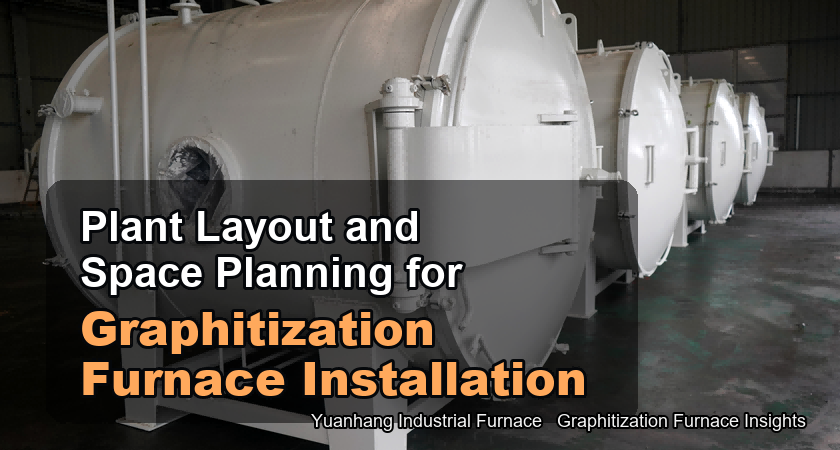
The furnace body size is only a part of the overall footprint; the supporting equipment also needs to be rationally laid out.
We will provide the following during the scheme design phase:
The equipment assembly drawing will indicate:
What the source article emphasizes
The Chinese source focuses on practical furnace selection and operation, not on a simple word-for-word product description. The important point is to understand how each specification affects real batch quality, operating cost, maintenance, and safety.
- How are the dimensions determined?
- Key Drawings and Documents
- Lifting Requirements
- Factory Building Height
Key technical points
- Effective heating zone size: Calculated based on material size, loading amount, and production capacity requirements
- Insulation layer thickness: Including the outer perimeter of the effective heating zone
- Furnace shell structure: Add another layer
- Auxiliary equipment: Space occupied by power cabinet, vacuum system, water cooling system, etc.
- Equipment Assembly Drawing: Overall dimensions (length, width, height)
- Equipment Foundation Layout Drawing: Foot locations, load distribution, and interface locations
- Space Requirements: Width of operating space and maintenance passage around the perimeter (recommended ≥1 meter, 1.5 meters if possible)
- Maximum single-piece weight and dimensions
Engineering interpretation for overseas buyers
Confirm whether the net height meets the requirements and reserve safety space. If height is limited, consider:
Experience: The earlier you get involved in factory planning, the better. Ideally, we should be involved before the factory is even built, designing the factory according to equipment requirements. This is the suitable approach.
For an English industrial furnace website, this topic should be presented in a way that helps the reader make a specification decision. That means connecting the furnace feature with material behavior, production rhythm, utility conditions, acceptance testing, and long-term maintenance.
Specification and acceptance checklist
- Define the effective heating zone instead of using total chamber size as the acceptance basis.
- Write the temperature uniformity value and verification method into the technical agreement.
- Use ceramic temperature rings or an equivalent method when high-temperature mapping cannot be measured directly.
- Use vacuum mainly for degassing, impurity removal, and low-temperature process stages.
- At very high temperatures, slight positive argon pressure can suppress graphite sublimation and prevent oxidation.
- The furnace control logic should make atmosphere switching repeatable rather than depending on operator memory.
- Heating elements and insulation determine maximum temperature, power consumption, maintenance interval, and batch cost.
- Consumable life depends on peak temperature, atmosphere purity, heating and cooling rate, and material volatility.
Questions to confirm before ordering
- What material will be treated, and what quality indicators must be reached after graphitization?
- What temperature curve, holding time, atmosphere, vacuum level, cooling method, and loading density are required?
- Which data will be recorded for each batch, and which acceptance tests will prove stable performance?
- Which spare parts, consumables, alarms, and maintenance checks are needed for long-term operation?
Engineering takeaway
A graphitization furnace should be specified as a complete high-temperature process system. When the buyer defines the material, process window, utilities, safety logic, and acceptance method clearly, the furnace is easier to operate, easier to troubleshoot, and more reliable in repeated production.



