



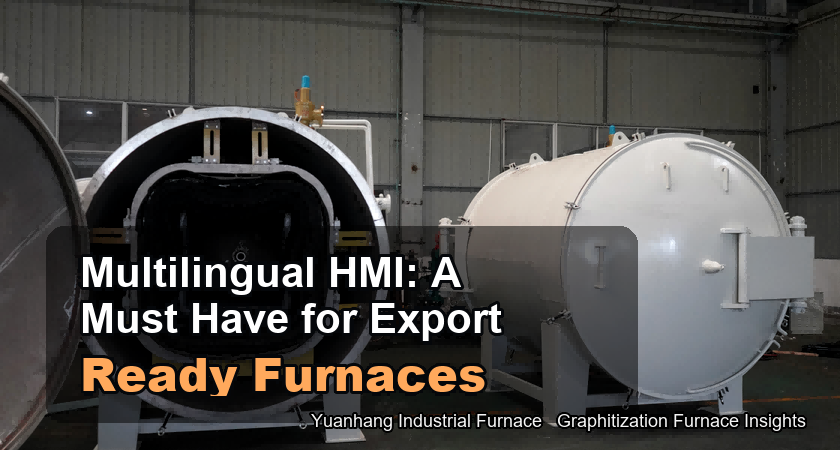
Multilingual HMI for Exported Graphitization Furnaces
The first time a foreign customer visits the factory, the interface is entirely in a foreign language, leaving the operators bewildered. Many export companies have encountered this scenario. Language barriers are the biggest obstacle when equipment arrives overseas. Our control system has built-in
The touchscreen operating interface supports multiple mainstream languages, including
Chinese, English, German, Japanese, and Spanish
Language switching is as simple as selecting it in the settings menu; the entire interface changes instantly, including all menus, buttons, alarm messages, and prompt text. No device restart or external file loading is required; the switching process takes only seconds.
What the source article emphasizes
The Chinese source focuses on practical furnace selection and operation, not on a simple word-for-word product description. The important point is to understand how each specification affects real batch quality, operating cost, maintenance, and safety.
- Multilingual HMI Interface
Key technical points
- Emergency design should cover power loss, cooling failure, gas interruption, overtemperature, and unsafe pressure.
- UPS, backup gas, safe sealing, and emergency cooling logic should be tested during commissioning.
- Alarm records should tell the operator what happened and what response is required.
- Confirm the process temperature, holding time, atmosphere, loading volume, and product quality indicators before comparing suppliers.
- Ask which indicators will be tested at the factory, which will be tested on site, and which need production verification.
- Keep one complete batch record for temperature, pressure, power, atmosphere, cooling water, alarms, and operator actions.
- Treat power supply, furnace body, vacuum, gas, cooling, control, and safety as one integrated system.
Engineering interpretation for overseas buyers
Operators in different countries have different usage habits. We offer interface customization services-adjusting button layouts, modifying terminology (e.g., "heating" can be changed to "Heating" or "Aufheizung"), adding the client's company logo, adjusting color themes, etc., according to customer requirements. This makes it as easy for overseas operators to use as if they were using local equipment.
Interface translation is just the first step. We also provide corresponding language versions of
operator manuals, maintenance guides, troubleshooting manuals
, and operation video tutorials with subtitles after scanning a QR code. Overseas customers do not need additional translation; they can begin training as soon as they receive the equipment.
For an English industrial furnace website, this topic should be presented in a way that helps the reader make a specification decision. That means connecting the furnace feature with material behavior, production rhythm, utility conditions, acceptance testing, and long-term maintenance.
Specification and acceptance checklist
- Emergency design should cover power loss, cooling failure, gas interruption, overtemperature, and unsafe pressure.
- UPS, backup gas, safe sealing, and emergency cooling logic should be tested during commissioning.
- Alarm records should tell the operator what happened and what response is required.
- Confirm the process temperature, holding time, atmosphere, loading volume, and product quality indicators before comparing suppliers.
- Ask which indicators will be tested at the factory, which will be tested on site, and which need production verification.
- Keep one complete batch record for temperature, pressure, power, atmosphere, cooling water, alarms, and operator actions.
- Treat power supply, furnace body, vacuum, gas, cooling, control, and safety as one integrated system.
Questions to confirm before ordering
- What material will be treated, and what quality indicators must be reached after graphitization?
- What temperature curve, holding time, atmosphere, vacuum level, cooling method, and loading density are required?
- Which data will be recorded for each batch, and which acceptance tests will prove stable performance?
- Which spare parts, consumables, alarms, and maintenance checks are needed for long-term operation?
Engineering takeaway
A graphitization furnace should be specified as a complete high-temperature process system. When the buyer defines the material, process window, utilities, safety logic, and acceptance method clearly, the furnace is easier to operate, easier to troubleshoot, and more reliable in repeated production.



