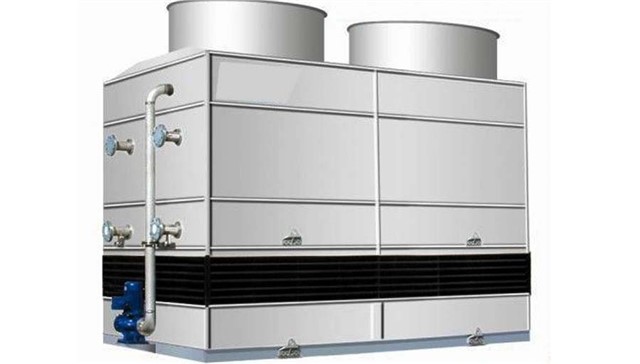
Based on our extensive experience in industrial furnace design and application, our company possesses profound expertise in designing circulating water cooling systems for industrial sites. We also have a seasoned and highly skilled construction team capable of effectively resolving numerous issues such as insufficient cooling capacity, winter freeze damage, water hammer, lack of automatic protection during power outages, system leakage, and pipe scaling. We provide design, selection, and installation services for industrial furnaces and other applications requiring circulating water cooling.Based on our extensive experience in long-term industrial furnace design and application, our company possesses profound expertise in designing circulating water cooling systems for industrial sites. We also have a seasoned and highly skilled construction team capable of effectively resolving numerous issues such as insufficient cooling capacity, winter freeze damage, water hammer, lack of automatic protection during power outages, system leakage, and pipe scaling. We provide design, selection, and installation services for industrial furnaces and other applications requiring circulating water cooling.
Function
The main function of the circulating water cooling tower system is to provide the required water flow, pressure, and quality, and to cool the inlet water to a specific temperature before discharging it to the industrial equipment.
Composition
A circulating water cooling tower system generally consists of inlet and outlet water pipes, flanges, expansion joints, valves, the cooling system, variable frequency pumps, a variable frequency control cabinet, a backup water source, and a seamless transfer backup power supply.
Cooling Tower Selection
Cooling Water Flow Calculation:
L = (Q1 + Q2) / (Δt * 1.163) * 1.1
L — Cooling water flow rate (m3/h)
Q1 — Total cooling load, multiplied by the simultaneous usage coefficient (KW)
Q2 — Power consumption of the compressor in the unit (KW)
Δt — Temperature difference between inlet and outlet cooling water (℃), generally taken as 4.5-5
Cooling Tower Water Flow:
Cooling tower water flow = Cooling water system water volume × (1.2~1.5)
Cooling Tower Capacity Correction:
The capacity of most cooling towers is rated under standard conditions (wet bulb temperature 28°C, inlet/outlet冷水温度 32°C/37°C). Due to regional differences, the summer wet bulb temperature varies and should be corrected based on curves provided in the manufacturer's catalog. Wet bulb temperature data can be obtained from local meteorological parameters.
The distance between the cooling tower and surrounding obstacles should be equal to one tower height.
Definition of Cooling Tower Refrigeration Ton (RT):
Under an air wet bulb temperature of 27°C, cooling 13L/min (0.78 m3/h) of pure water from 37°C to 32°C equals 1 refrigeration ton, with a heat rejection capacity of 4.515 KW.
For every 1°C increase in wet bulb temperature, cooling efficiency decreases by approximately 17%.
Cooling Tower Capacity Calculation:
Q = 72 * L * (h1 - h2)
Q — Cooling capacity (Kcal/h)
L — Cooling tower air volume (m3/h)
h1 — Air enthalpy at cooling tower inlet
h2 — Air enthalpy at cooling tower outlet
If automatic control is implemented for the cooling tower, electric valves must be installed on both the inlet and outlet pipes to prevent back suction or overflow during single-unit control.
Determination of Cooling Water Pump Head
The pump head is the sum of: the resistance of the cooling water system + the height difference between the cooling tower basin and the water distributor + the pressure required by the water distributor.
5. Different Types of Cooling Tower Noise and Treatment Methods:
(Content omitted)
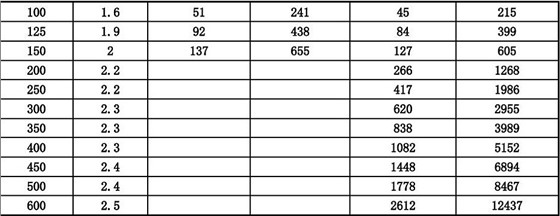
6. Cooling Pipe Diameter Selection:
(Content omitted)
Cooling Water Pump Head:
Head generally refers to the maximum height a pump can lift water, denoted by H. The most common formula for calculating pump head is:
H = (p2 - p1) / ρg + (c2 - c1) / 2g + z2 - z1
Where:
H — Head, m
p1, p2 — Liquid pressure at the pump inlet and outlet, Pa
c1, c2 — Fluid velocity at the pump inlet and outlet, m/s
z1, z2 — Height at inlet and outlet, m
ρ — Liquid density, kg/m3
g — Gravitational acceleration, m/s2
Typically, a clean water centrifugal pump with a specific speed (ns) between 130 and 150 is selected. The pump flow rate should be 1.1 to 1.2 times the rated flow of the chiller (1.1 for a single unit, 1.2 for two units in parallel).
For estimation, the friction loss per 100 meters of pipe length can be approximately taken as 5 mH?O. The pump head formula (mH?O) is:
Hmax = △P1 + △P2 + 0.05L (1 + K)
△P1 is the water pressure drop of the chiller evaporator.
△P2 is the water pressure drop of the unit with the highest pressure loss among the parallel-connected terminal devices in the circuit.
L is the pipe length of the most unfavorable circuit.
K is the ratio of the total equivalent length of local resistances to the total straight pipe length in the most unfavorable circuit. When the most unfavorable circuit is long, K is taken as 0.2–0.3; when it is short, K is taken as 0.4–0.6.
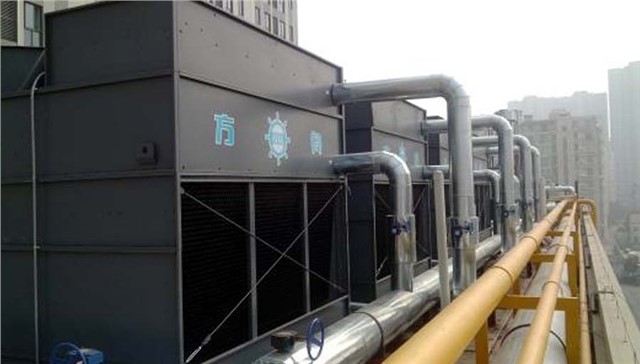
Note: Our company only provides design and installation services for cooling circulation water systems and does not manufacture cooling towers. The images of cooling towers on this website are sourced from the internet. If there is any infringement, please contact us for removal.
Based on our extensive experience in long-term industrial furnace design and application, our company possesses profound expertise in designing circulating water cooling systems for industrial sites. We also have a seasoned and highly skilled construction team capable of effectively resolving numerous issues such as insufficient cooling capacity, winter freeze damage, water hammer, lack of automatic protection during power outages, system leakage, and pipe scaling. We provide design, selection, and installation services for industrial furnaces and other applications requiring circulating water cooling.
Function
The main function of the circulating water cooling tower system is to provide the required water flow, pressure, and quality, and to cool the inlet water to a specific temperature before discharging it to the industrial equipment.
Composition
A circulating water cooling tower system generally consists of inlet and outlet water pipes, flanges, expansion joints, valves, the cooling system, variable frequency pumps, a variable frequency control cabinet, a backup water source, and a seamless transfer backup power supply.
Cooling Tower Selection
Cooling Water Flow Calculation:
L = (Q1 + Q2) / (Δt * 1.163) * 1.1
-
L — Cooling water flow rate (m³/h)
-
Q1 — Total cooling load, multiplied by the simultaneous usage coefficient (KW)
-
Q2 — Power consumption of the compressor in the unit (KW)
-
Δt — Temperature difference between inlet and outlet cooling water (℃), generally taken as 4.5-5
Cooling Tower Water Flow:
Cooling tower water flow = Cooling water system water volume × (1.2~1.5)
Cooling Tower Capacity Correction:
The capacity of most cooling towers is rated under standard conditions (wet bulb temperature 28°C, inlet/outlet冷水温度 32°C/37°C). Due to regional differences, the summer wet bulb temperature varies and should be corrected based on curves provided in the manufacturer's catalog. Wet bulb temperature data can be obtained from local meteorological parameters.
The distance between the cooling tower and surrounding obstacles should be equal to one tower height.
Definition of Cooling Tower Refrigeration Ton (RT):
Under an air wet bulb temperature of 27°C, cooling 13L/min (0.78 m³/h) of pure water from 37°C to 32°C equals 1 refrigeration ton, with a heat rejection capacity of 4.515 KW.
For every 1°C increase in wet bulb temperature, cooling efficiency decreases by approximately 17%.
Cooling Tower Capacity Calculation:
Q = 72 * L * (h1 - h2)
-
Q — Cooling capacity (Kcal/h)
-
L — Cooling tower air volume (m³/h)
-
h1 — Air enthalpy at cooling tower inlet
-
h2 — Air enthalpy at cooling tower outlet
If automatic control is implemented for the cooling tower, electric valves must be installed on both the inlet and outlet pipes to prevent back suction or overflow during single-unit control.
Determination of Cooling Water Pump Head
The pump head is the sum of: the resistance of the cooling water system + the height difference between the cooling tower basin and the water distributor + the pressure required by the water distributor.
5. Different Types of Cooling Tower Noise and Treatment Methods:
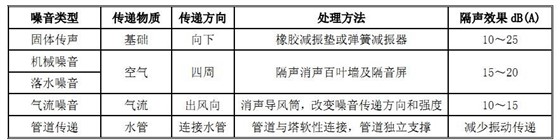
6. Cooling Pipe Diameter Selection:
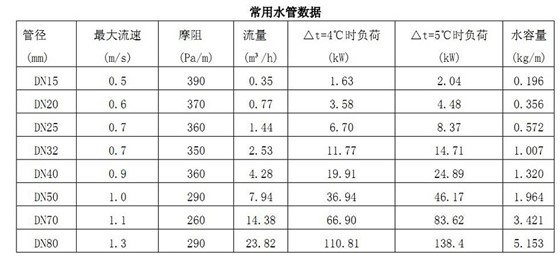
Cooling Water Pump Head:
Head generally refers to the maximum height a pump can lift water, denoted by H. The most common formula for calculating pump head is:
H = (p2 - p1) / ρg + (c2 - c1) / 2g + z2 - z1
Where:
-
H — Head, m
-
p1, p2 — Liquid pressure at the pump inlet and outlet, Pa
-
c1, c2 — Fluid velocity at the pump inlet and outlet, m/s
-
z1, z2 — Height at inlet and outlet, m
-
ρ — Liquid density, kg/m³
-
g — Gravitational acceleration, m/s²
Typically, a clean water centrifugal pump with a specific speed (ns) between 130 and 150 is selected. The pump flow rate should be 1.1 to 1.2 times the rated flow of the chiller (1.1 for a single unit, 1.2 for two units in parallel).
For estimation, the friction loss per 100 meters of pipe length can be approximately taken as 5 mH?O. The pump head formula (mH?O) is:
Hmax = △P1 + △P2 + 0.05L (1 + K)
-
△P1 is the water pressure drop of the chiller evaporator.
-
△P2 is the water pressure drop of the unit with the highest pressure loss among the parallel-connected terminal devices in the circuit.
-
L is the pipe length of the most unfavorable circuit.
-
K is the ratio of the total equivalent length of local resistances to the total straight pipe length in the most unfavorable circuit. When the most unfavorable circuit is long, K is taken as 0.2–0.3; when it is short, K is taken as 0.4–0.6.
Note: Our company only provides design and installation services for cooling circulation water systems and does not manufacture cooling towers. The images of cooling towers on this website are sourced from the internet. If there is any infringement, please contact us for removal.