


Question:Which gases can be introduced? Can the gas inlet and exhaust be precisely controlled using mass flow controllers? What is the pressure control range?
Detailed Answer:
The furnace atmosphere acts as the "guardian" of the high-temperature graphitization process. Precisely controlling the purity, flow rate, and pressure of the atmosphere is paramount to ensuring product quality and extending equipment lifespan. Our system provides refined solutions for this purpose.
I. Selection of Protective Gas: Nitrogen or Argon?
This is not an arbitrary choice but a scientific decision strictly determined by the process temperature:
-
Operating Conditions ≤ 2200°C:At this temperature,high-purity nitrogen (N?), which is relatively chemically stable, serves as an economical and efficient choice. It effectively isolates oxygen at a relatively low cost.
-
Operating Conditions > 2200°C:When the temperature exceeds 2200°C, nitrogen reacts with graphite components to form cyanides, which not only corrode the equipment but also contaminate the products. Therefore, the use of chemically inerthigh-purity argon (Ar)as a protective gas is mandatory. Our equipment, designed for maximum temperatures up to 3200°C, is fundamentally based on argon atmosphere protection.
-
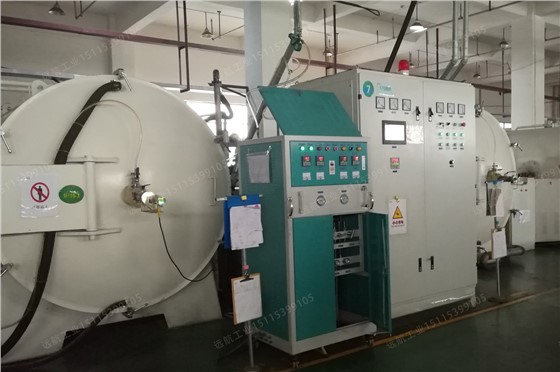
II. The Heart of Control Precision: Mass Flow Controllers (MFCs)
We have moved beyond simple on/off valve control. Both the gas inlet and exhaust ends are equipped withMass Flow Controllers (MFCs)for precise regulation.
-
Working Principle and Advantages:An MFC monitors and controls the mass flow rate of the passing gas in real-time,不受影响 by fluctuations in ambient temperature or pressure. This means you can set a precise flow value (e.g., 2.5 liters per minute), and the system will automatically maintain it constantly, ensuring high process repeatability.
III. Pressure Control Range: The Optimal Zone of Slight Positive Pressure
The equipment typically operates within aslight positive pressure range of 500 Pa to 1500 Pa (relative pressure).
-
Why Slight Positive Pressure?The purpose of this pressure setting is to ensure that the pressure inside the furnace is always slightly higher than the external atmospheric pressure. This way, even if an extremely minor leak exists, it results in pure protective gas seepingoutfrom the furnace, effectively preventing the intrusion of external air (oxygen, moisture). This provides an absolutely safe "protective shield" for the high-temperature process. You can set an optimal pressure value within this range according to your process requirements.
The above technical article is exclusively written by Yuanhang Industrial Furnace Company. Reproduction is prohibited.