


Indirect Furnace Monitoring from Pressure to Gas Analysis
What is the state inside a graphitization furnace when it is working? At temperatures of several thousand degrees Celsius, protective gases are flowing, and materials are undergoing complex physicochemical reactions, including graphite sublimation carbon vapor, carbon nanoclusters, SiO vapor (if some oxygen is present), metal vapor, submicron particles, and condensed carbon filaments. There are even glow discharges between induction coil turns or conductive dust in various locations. These things are completely invisible to the naked eye, but those working on the process desperately want to know what is happening inside. How can this be addressed?
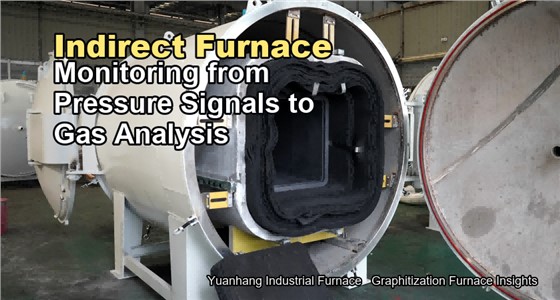
Our system has two levels for furnace monitoring.
This is standard equipment in every graphitization furnace, no extra cost required:
How much gas enters, how much gas exits, and how the furnace pressure changes-these core atmospheric parameters are under the system's control from beginning to end.
What the source article emphasizes
The Chinese source focuses on practical furnace selection and operation, not on a simple word-for-word product description. The important point is to understand how each specification affects real batch quality, operating cost, maintenance, and safety.
- First Layer: Basic Configuration (Standard)
- Second Tier: Advanced Optional Equipment (In-depth R&D)
- Three Major Practical Applications
Key technical points
- Pressure Monitoring: Real-time recording of furnace pressure change curves, supporting both absolute and relative pressure modes.
- Flow Monitoring: Records the set and actual flow rates of the MFC at the inlet and outlet ends throughout the entire process.
- Mass Spectrometer: Real-time monitoring of various gas components and concentration changes within the furnace, trace-level sensitivity
- Gas Chromatograph: Higher quantitative accuracy, suitable for precise component determination
- Oxygen Analyzer: Specifically monitors oxygen content, directly related to the product's oxidation level and safety
- Dew Point Meter: Monitors the moisture content of protective gases, a critical threshold for high-end graphite materials
- Process Development: Precisely understanding what gases are released by materials at different temperatures and the extent of the reaction.
- Endpoint Judgment: Monitoring the concentration trend of characteristic gases to help determine whether the reaction is complete and avoid under-burning or over-burning.
Engineering interpretation for overseas buyers
For customers requiring in-depth process R&D:
Summary: From basic pressure and flow monitoring to advanced gas composition analysis, a complete capability gradient from shallow to deep has been formed. Although the situation inside the furnace is invisible, with the help of data and instruments, you can see it much more clearly than before.
For an English industrial furnace website, this topic should be presented in a way that helps the reader make a specification decision. That means connecting the furnace feature with material behavior, production rhythm, utility conditions, acceptance testing, and long-term maintenance.
Specification and acceptance checklist
- At about 3000 °C, stable power, high-purity argon, low dew point, and reliable cooling must work as one system.
- For high-purity graphite work, confirm oxygen and moisture control before loading valuable material.
- Nitrogen should not be treated as a simple substitute for argon in ultra-high-temperature graphite service.
- Use vacuum mainly for degassing, impurity removal, and low-temperature process stages.
- At very high temperatures, slight positive argon pressure can suppress graphite sublimation and prevent oxidation.
- The furnace control logic should make atmosphere switching repeatable rather than depending on operator memory.
- Leak checking before heating is essential when processing high-value graphite or carbon materials.
- Water-cooled flanges and suitable O-rings help keep sealing parts below their thermal aging limit.
Questions to confirm before ordering
- What material will be treated, and what quality indicators must be reached after graphitization?
- What temperature curve, holding time, atmosphere, vacuum level, cooling method, and loading density are required?
- Which data will be recorded for each batch, and which acceptance tests will prove stable performance?
- Which spare parts, consumables, alarms, and maintenance checks are needed for long-term operation?
Engineering takeaway
A graphitization furnace should be specified as a complete high-temperature process system. When the buyer defines the material, process window, utilities, safety logic, and acceptance method clearly, the furnace is easier to operate, easier to troubleshoot, and more reliable in repeated production.