


Detailed Answer:
When selecting a high-temperature graphitization furnace for your production process, temperature performance is a core consideration. It directly determines the types of materials the equipment can process and the level of technology achievable. This article will break down several key temperature parameters for you.
I. Design Maximum Temperature vs. Nominal Temperature
· Design Maximum Temperature: This refers to the ultimate temperature tolerance for which the equipment is designed, representing the equipment's safety margin and material limits. Our equipment is designed to reach a maximum temperature of up to 3200°C, ensuring safety and reliability under extreme operating conditions.
· Nominal Temperature / Long-term Stable Operating Temperature: This is the indicator directly relevant to your production process. We adhere to the principle of customization based on your needs. You inform us of the long-term working temperature required by your process (e.g., 2850°C), and we will use this as the equipment's nominal temperature. To ensure long-term operational stability, we reserve a safety margin of 50-100°C during design and manufacturing. This means that for a furnace nominally rated at 2850°C, its internal materials and structure are built to a 2900°C standard. However, during acceptance testing, we still use 2850°C as the benchmark, providing you with a more stable and longer-lasting equipment lifecycle.
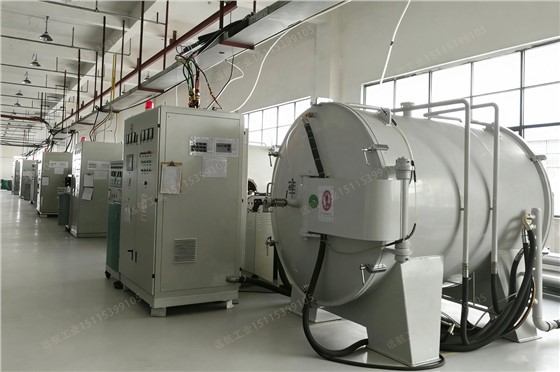
How long does it take to heat from room temperature to 3000°C? This is an excellent question, but the answer is not a fixed value. It mainly depends on two key factors:
· Material Characteristics and Batch Size: Different materials have different specific heat capacities, endothermic/exothermic reactions, which directly affect the energy consumption and time required for heating. For example, the heating curve for processing carbon fiber will differ from that for processing silicon carbide powder.
· Effective Furnace Chamber Volume: This is the decisive factor. Generally, the smaller the furnace chamber, the lower the thermal inertia, and the faster the heating rate. We roughly categorize it as follows:
· Small-Scale Experimental Furnaces (< 30L): Suitable for R&D and small-batch trial production, heating up quickly. The process from room temperature to 3000°C can typically be completed within 3 hours.
· Medium-Scale Production Furnaces (≈ 100L): Balances output and efficiency. The heating time is approximately 5 hours.
· Large-Scale Industrial Furnaces (> 100L): Designed for mass production. Due to the huge heat capacity, the heating process is gentler and typically requires around 15 hours.
The above technical article is exclusively written by Yuanhang Industrial Furnace Company. Reproduction is prohibited.