


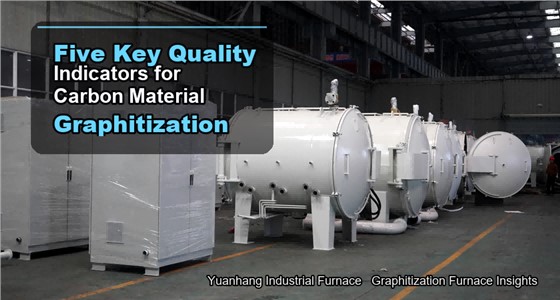
Five Quality Indicators for Carbon Material Graphitization
The quality of graphitization cannot be judged by intuition; it must be based on data. The following are five key indicators for evaluating the quality of graphitization:
The degree of graphitization is an indicator that measures the extent to which carbon materials are transformed into a graphite structure. It is usually determined by measuring theusing X-ray diffraction (XRD). The d002 of ideal graphite is 3.354 ?, and the d002 of amorphous carbon is approximately 3.44 ?.
The higher the degree of graphitization, the closer d002 is to 3.354 ?. General requirements:
What the source article emphasizes
The Chinese source focuses on practical furnace selection and operation, not on a simple word-for-word product description. The important point is to understand how each specification affects real batch quality, operating cost, maintenance, and safety.
- Five Key Quality Indicators for Graphitization of Carbon Materials
- 1. Degree of Graphitization
- 2. Stability
- 3. Flexural Strength
Key technical points
- High-purity graphite: Graphitization degree >90%
- Ordinary graphite: Graphitization degree >80%
- A new furnace should be purified before high-purity products are loaded.
- Moisture, oil, machining residue, and background contaminants can remain inside a new hot zone.
- Purification temperature, vacuum stage, gas replacement, and acceptance criteria should be recorded.
- Digital interfaces should provide useful production data, not just a remote screen view.
- Temperature curves, power data, pressure trends, alarms, and operator actions are valuable for quality traceability.
- MES or SCADA integration should be defined by data points, communication protocol, permissions, and reporting needs.
Engineering interpretation for overseas buyers
The higher the degree of graphitization, the lower the stability of the material. Measured using the
, the unit is μΩ·m. The stability of high-quality graphite can be as low as 5-10 μΩ·m. Stability is a direct reflection of the product's conductivity and is one of the indicators most concerned by customers.
The mechanical properties of graphite materials are determined using the
If the temperature is not properly controlled or the material is rapidly cooled during graphitization, microcracks will form inside the material, leading to a decrease in flexural strength. A balance needs to be found between flexural strength and the degree of graphitization-excessive graphitization, while improving electrical conductivity, may reduce strength.
For an English industrial furnace website, this topic should be presented in a way that helps the reader make a specification decision. That means connecting the furnace feature with material behavior, production rhythm, utility conditions, acceptance testing, and long-term maintenance.
Specification and acceptance checklist
- A new furnace should be purified before high-purity products are loaded.
- Moisture, oil, machining residue, and background contaminants can remain inside a new hot zone.
- Purification temperature, vacuum stage, gas replacement, and acceptance criteria should be recorded.
- Digital interfaces should provide useful production data, not just a remote screen view.
- Temperature curves, power data, pressure trends, alarms, and operator actions are valuable for quality traceability.
- MES or SCADA integration should be defined by data points, communication protocol, permissions, and reporting needs.
- Confirm the process temperature, holding time, atmosphere, loading volume, and product quality indicators before comparing suppliers.
- Ask which indicators will be tested at the factory, which will be tested on site, and which need production verification.
Questions to confirm before ordering
- What material will be treated, and what quality indicators must be reached after graphitization?
- What temperature curve, holding time, atmosphere, vacuum level, cooling method, and loading density are required?
- Which data will be recorded for each batch, and which acceptance tests will prove stable performance?
- Which spare parts, consumables, alarms, and maintenance checks are needed for long-term operation?
Engineering takeaway
A graphitization furnace should be specified as a complete high-temperature process system. When the buyer defines the material, process window, utilities, safety logic, and acceptance method clearly, the furnace is easier to operate, easier to troubleshoot, and more reliable in repeated production.