


Cooling Water Alarms in Graphitization Furnace Safety Design
Does the cooling water in the graphitization furnace have an alarm? Triple Sensors + Two-Level Alarms + Mechanical Redundancy: In-Furnace Quality Assurance System
If you compare the graphitization furnace to a person, the cooling water is its blood. The induction coil generates enormous heat when operating at high current. Without continuous cooling water to dissipate this heat, the coil will burn out, deform, and become unusable within minutes. I have seen cases where coils burned out due to cooling water interruption, resulting in losses of hundreds of thousands.
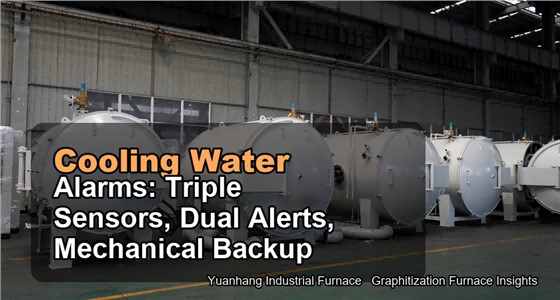
The water cooling system is not a secondary role; it is the lifeline. The core idea can be summarized in three words:
Flow, pressure, and temperature cover the three core dimensions of the cooling water system, forming a triple protection network.
What the source article emphasizes
The Chinese source focuses on practical furnace selection and operation, not on a simple word-for-word product description. The important point is to understand how each specification affects real batch quality, operating cost, maintenance, and safety.
- Triple Sensor Protection
- Two-level alarm mechanism
- Mechanical redundancy protection
Key technical points
- Flow Sensor: Real-time monitoring of water flow in each channel; alarms when flow is below the set value; automatically cuts off heating power if flow is severely low.
- Pressure Sensor: Monitors inlet water pressure (0.1-0.2MPa), detecting pump aging or pipe blockage trends in advance.
- Temperature Sensor: Installed at critical locations such as the coil outlet; excessively high outlet water temperature indicates poor heat dissipation.
- Cooling water should be monitored by flow, pressure, and temperature, not only by pump running status.
- Independent circuits are preferred for the shell, induction coil, power cabinet, and key electrical components.
- Emergency or redundant cooling should be considered for high-value batches and unattended operation.
- Emergency design should cover power loss, cooling failure, gas interruption, overtemperature, and unsafe pressure.
- UPS, backup gas, safe sealing, and emergency cooling logic should be tested during commissioning.
Engineering interpretation for overseas buyers
Warning Parameter approaching safety limit Gentle audio and visual prompts give processing time
Over-limit Parameter exceeds safety limit Immediately stop heating + strong alarm
In addition to electronic sensors, the pipeline is also equipped with a mechanical electrical contact pressure gauge and flow switch -a purely mechanical structure, independent of PLC and circuits. When water pressure is abnormal or flow is interrupted, it directly cuts off the main circuit to stop the equipment. Like a fuse, it works silently most of the time, but steps up in critical moments.
Summary: Triple electronic sensors + two-level alarm mechanism + mechanical redundancy protection. Behind each layer of protection may lie a real lesson. We cannot allow a second chance when it comes to coolant.
For an English industrial furnace website, this topic should be presented in a way that helps the reader make a specification decision. That means connecting the furnace feature with material behavior, production rhythm, utility conditions, acceptance testing, and long-term maintenance.
Specification and acceptance checklist
- Cooling water should be monitored by flow, pressure, and temperature, not only by pump running status.
- Independent circuits are preferred for the shell, induction coil, power cabinet, and key electrical components.
- Emergency or redundant cooling should be considered for high-value batches and unattended operation.
- Emergency design should cover power loss, cooling failure, gas interruption, overtemperature, and unsafe pressure.
- UPS, backup gas, safe sealing, and emergency cooling logic should be tested during commissioning.
- Alarm records should tell the operator what happened and what response is required.
- Acceptance criteria should be measurable and written into the contract before manufacturing is completed.
- Site readiness, utilities, lifting, foundation, gas supply, cooling water, and exhaust treatment all affect commissioning.
Questions to confirm before ordering
- What material will be treated, and what quality indicators must be reached after graphitization?
- What temperature curve, holding time, atmosphere, vacuum level, cooling method, and loading density are required?
- Which data will be recorded for each batch, and which acceptance tests will prove stable performance?
- Which spare parts, consumables, alarms, and maintenance checks are needed for long-term operation?
Engineering takeaway
A graphitization furnace should be specified as a complete high-temperature process system. When the buyer defines the material, process window, utilities, safety logic, and acceptance method clearly, the furnace is easier to operate, easier to troubleshoot, and more reliable in repeated production.